Best AI visibility tools in 2026: the buyer's shortlist.
Compare eight AI visibility tools for SaaS, app, and plugin teams. See pricing, prompt tracking, AI engine coverage, and the fit for your marketing workflow.
Your next customer asks ChatGPT which software to buy. The answer names three competitors, cites a comparison you have never seen, and leaves your product out.
You need to know which questions produce that result, which sources shape the answer, and whether the problem sits on your website or somewhere else.
This 2026 shortlist covers the best AI visibility tools for SaaS, app, and plugin companies. Peec AI takes the top spot for marketing teams that want clear prompt tracking, citation analysis, and a fixed monthly price.
Key Takeaways
The short version, before you compare the tools.
Track buying questions, not only your brand name. A useful prompt set covers category discovery, comparisons, and the requirements that decide a purchase. You want to see whether your product appears before the buyer already knows it exists.
Peec AI leads for a focused marketing workflow. Starter is $95 per month for 50 prompts, three chosen models, daily tracking, and unlimited users. Visibility, sentiment, competitor share of voice, and cited sources help your team decide what to work on next.
Engine coverage depends on the plan. A vendor may support ChatGPT, Perplexity, Gemini, Copilot, Claude, and Google's AI search experiences across its product, while including a smaller selection at the entry price. Compare the models you actually intend to monitor.
Prompts and credits measure different things. AthenaHQ charges one credit per AI response. Rankscale uses credits across its platform, while Ahrefs Custom Prompts consume checks by platform, location, and update. Write down your monitoring schedule before comparing allowances.
Monitoring and execution are separate jobs. Profound combines insights with agents that research, write, and report. Scrunch adds website optimization for AI agents, while Otterly.AI includes GEO audits on its $29 per month Lite plan.
Mentions, citations, and visits answer different questions. A brand mention tells you that your product appeared. A citation identifies a source, and traffic reporting measures visits that reached your site. Use them together when you judge whether visibility is helping acquisition.
What AI visibility tools actually are (and what they are not)
AI visibility tools show how your brand appears when people ask AI systems for recommendations and explanations. You give the platform questions to monitor, or use its existing prompt index, then review brand mentions, competitors, sentiment, and cited pages. These products are also described as generative engine optimization tools, or GEO tools, and answer engine optimization tools, or AEO tools.
For a SaaS business, the useful questions follow a buying journey. Someone might ask for a customer feedback tool, compare two shortlisted products, then ask which one supports their billing provider. Track the questions your buyers need answered, including the markets where you sell. A mention on a broad category prompt and an accurate answer about a specific integration deserve separate attention.
The next step is investigating the sources. An answer may draw on your own feature page, a review, a comparison post, a creator video, or a community thread. Citation analysis helps you decide whether to clarify owned pages or work with the people publishing about your category. The tool measures those appearances; your team still owns the work that follows.
This software does not replace product analytics or prove that a mention caused a sale. You still need to connect visits with trials and paid accounts. Use the free UTM link builder to tag the links you control in partner content and campaigns, then compare that traffic with identifiable AI referrals in your analytics.
How We Ranked These AI Visibility Tools
This shortlist evaluates tools for SaaS, app, and plugin teams that want to understand how AI answers describe their products. The focus is buyer questions, cited sources, and the work your marketing team can do with the findings.
Public pricing, product pages, and vendor documentation provide the basis for comparing capabilities and plan capacity. General SEO suites appear here only through their AI visibility products.
We compared five criteria:
Prompt tracking. Custom buying questions, update frequency, locations, and the difference between monitoring your own prompts and searching a vendor's existing index. A useful setup reflects the decisions your customers make.
Engine coverage. Named AI platforms, what the entry plan includes, and which engines require an add-on or enterprise agreement. Google AI Overviews and AI Mode remain separate experiences in the comparison.
Sources and competitive context. Citations, competitor mentions, sentiment, and share of voice. These help explain why an answer deserves attention and which page or publisher to investigate.
Actions and operational access. Content recommendations, technical audits, optimization agents, exports, APIs, and MCP access. The question is how findings become work in your existing marketing process.
Cost and capacity. Monthly fees, prompt or response allowances, model selection, workspaces, and team access. Credits, checks, and unique prompts keep their own units rather than becoming one misleading allowance.
Published customer results are attributed to the vendor reporting them. The ranking favors a clear day-to-day workflow for SaaS marketing teams, with enterprise execution, category research, and agency operations represented separately. We plan to review this guide quarterly and after material pricing changes.
The Best AI Visibility Tools in 2026
Start with the questions that could put your product on a buyer's shortlist. The tools below differ in how they monitor those questions, explain cited sources, and help your team act. These eight options cover focused analytics, enterprise agents, SEO-suite extensions, website optimization, and agency reporting.
1. Peec AI, best for clear prompt tracking at a fixed monthly price
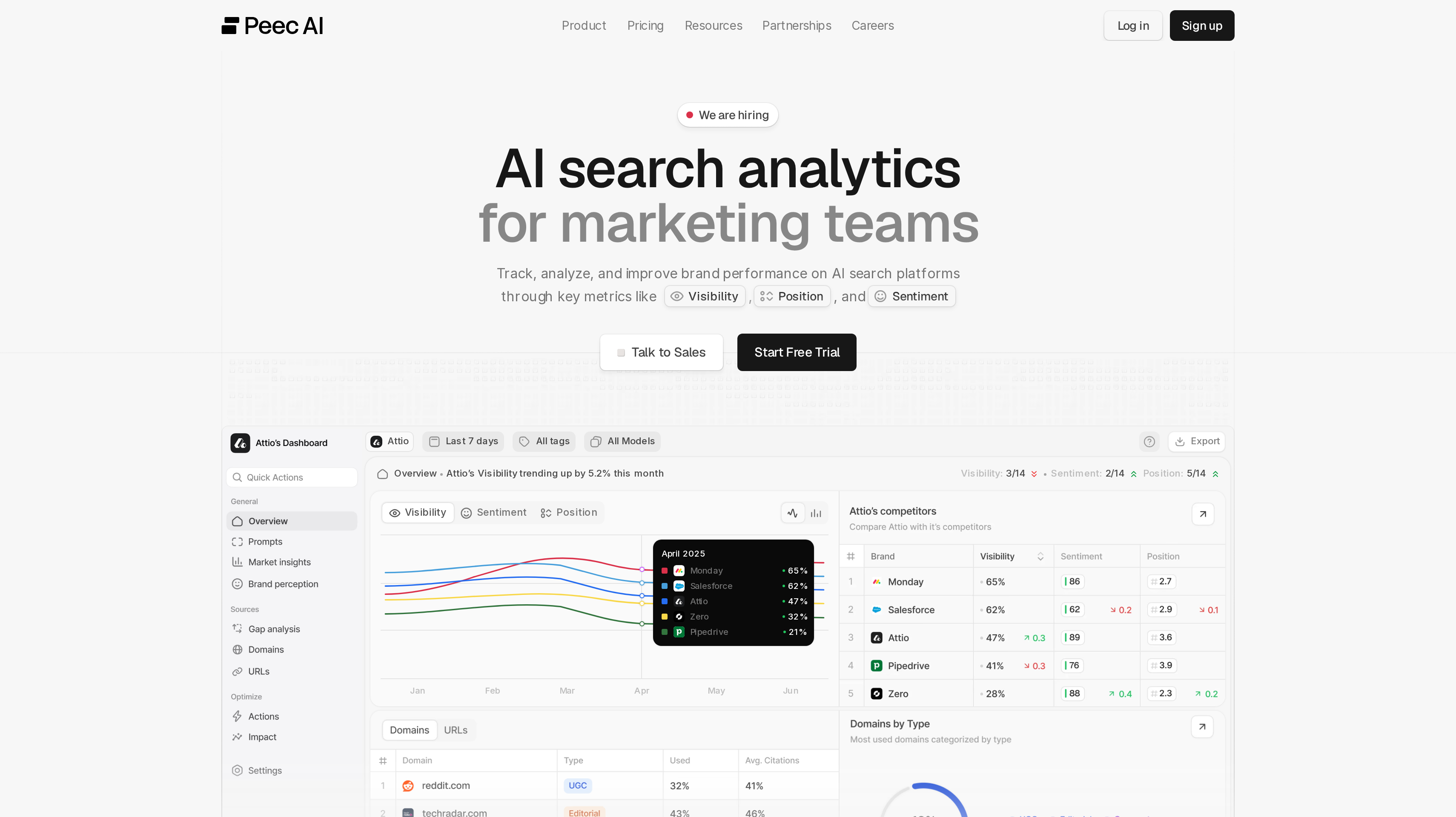
Peec AI is AI search analytics for marketing teams. It measures visibility as the share of chats mentioning your brand, alongside position, sentiment, and share of voice against competitors. Tags organize your prompts, and country tracking helps separate markets. That combination of focused reporting and published monthly plans is why it leads this shortlist for SaaS marketers.
Source analytics shows the domains and URLs that AI cites, with source classification, gap analysis, and recommended actions. Your team can move from a missing mention to the pages worth investigating. AI-suggested prompts with prompt volume also help you build a question set beyond the phrases your own team already uses.
Starter is $95 per month on monthly billing for 50 prompts, three chosen models, daily tracking, and one project. Pro is $245 per month for 150 prompts and two projects. Advanced is $495 per month for 350 prompts, five projects, multi-country tracking, and Looker Studio integration. Every plan includes unlimited users, and a free trial is available.
Enterprise has custom annual pricing, customizable prompt tracking across up to 13 models, unlimited projects, API access, and SSO. Peec also offers CSV export, a Looker Studio community connector, and connections to Claude, Cursor, n8n, and other tools through MCP and API. If reports should feed recurring tasks, our workflow automation shortlist covers that next buying decision.
Best suited for SaaS marketing teams that want a shared daily view of prompts, competitors, and cited sources. Unlimited users lets content and growth colleagues work from the same reporting without counting seats.
2. Profound, best for enterprise AI search with agents and agent analytics
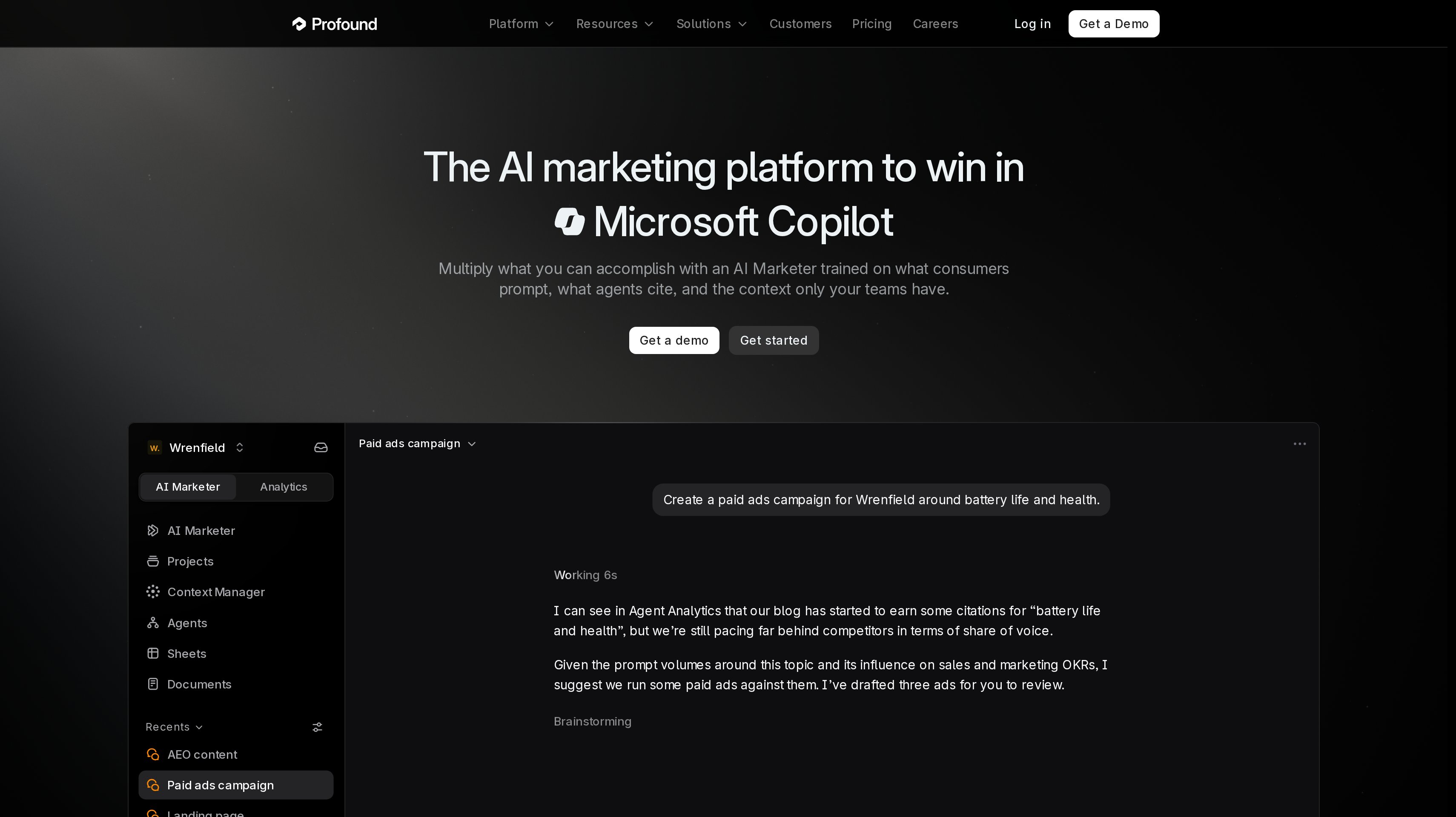
Profound combines AI search measurement with an AI Marketer that researches, writes, and reports. A Context Manager holds brand knowledge, reusable Agents handle recurring work, and Profound Sheets runs agents at scale. Drafts wait for approval, so a marketing team can review output before it moves into publication.
Answer Engine Insights covers brand and competitor appearances, citation analytics, and visibility scores by platform. Prompt Volumes shows what users ask AI answer engines. Together, those products connect the questions your audience asks with the answers and sources your team needs to understand. You can use that context to decide which content deserves an update before asking an agent to draft it.
Agent Analytics measures AI-sourced traffic and attribution across your domains. Its listed integrations include Cloudflare, Google Analytics, Netlify, Vercel, WordPress, and other hosting and infrastructure providers. This gives the team a separate way to examine visits alongside answer visibility, rather than treating every mention as traffic.
The free Trial includes limited AI Marketer credits and 50 prompts run daily for seven days across ChatGPT, Gemini, and Google AI Overviews. It includes unlimited seats and unlimited domains for Agent Analytics, with one language and one region. Enterprise pricing is custom, with tailored tracking across up to nine answer engines, ChatGPT Shopping, all-time history, CSV and JSON exports, API access, and SSO/SAML. Separate agency pricing is available.
Best suited for enterprise marketing teams that want AI search reporting and agent-assisted execution in the same platform. Brand context, approval stages, and agent traffic analytics support teams coordinating research, content, and reporting across departments.
3. Semrush AI Visibility Toolkit, best for teams already running SEO in Semrush
Semrush AI Visibility Toolkit adds AI answer reporting to the Semrush product range. Visibility Overview shows an AI Visibility Score based on how often your brand appears compared with the median of automatically identified industry competitors. Brand Performance examines mentions, tone, and attributes in answers to common queries, including those run through ChatGPT and Google AI Mode.
Prompt Tracking monitors specific questions daily on platforms such as ChatGPT and Google AI Mode. For an existing Semrush team, the appeal is putting AI discovery next to the SEO work already in its process. You can examine whether an answer describes your product accurately, then use the recommendations to choose a content task.
The standalone toolkit costs $99 per month and has no free trial. An extra 50 prompts costs $60 per month. Each additional domain or location for Brand Performance costs $99 per month, and each corporate subuser needs a separate $99 toolkit license. CSV exports support up to 1,000 rows per export.
Semrush One bundles SEO and AI Visibility. Starter is $199 per month on monthly billing, or $165.17 per month billed annually, with 50 prompts tracked daily, one Brand Performance domain, 300 AI visibility reports per day, AI-ready Site Audit, and MCP access. Pro+ is $299 per month on monthly billing, or $248.17 billed annually, with 100 daily prompts. Advanced has custom pricing and unlimited prompts tracked daily.
Best suited for teams whose SEO reporting and site audits already run in Semrush. The standalone toolkit and Semrush One bundle give you separate ways to add AI search work to that setup.
4. Ahrefs Brand Radar, best for benchmarking against a large prompt index
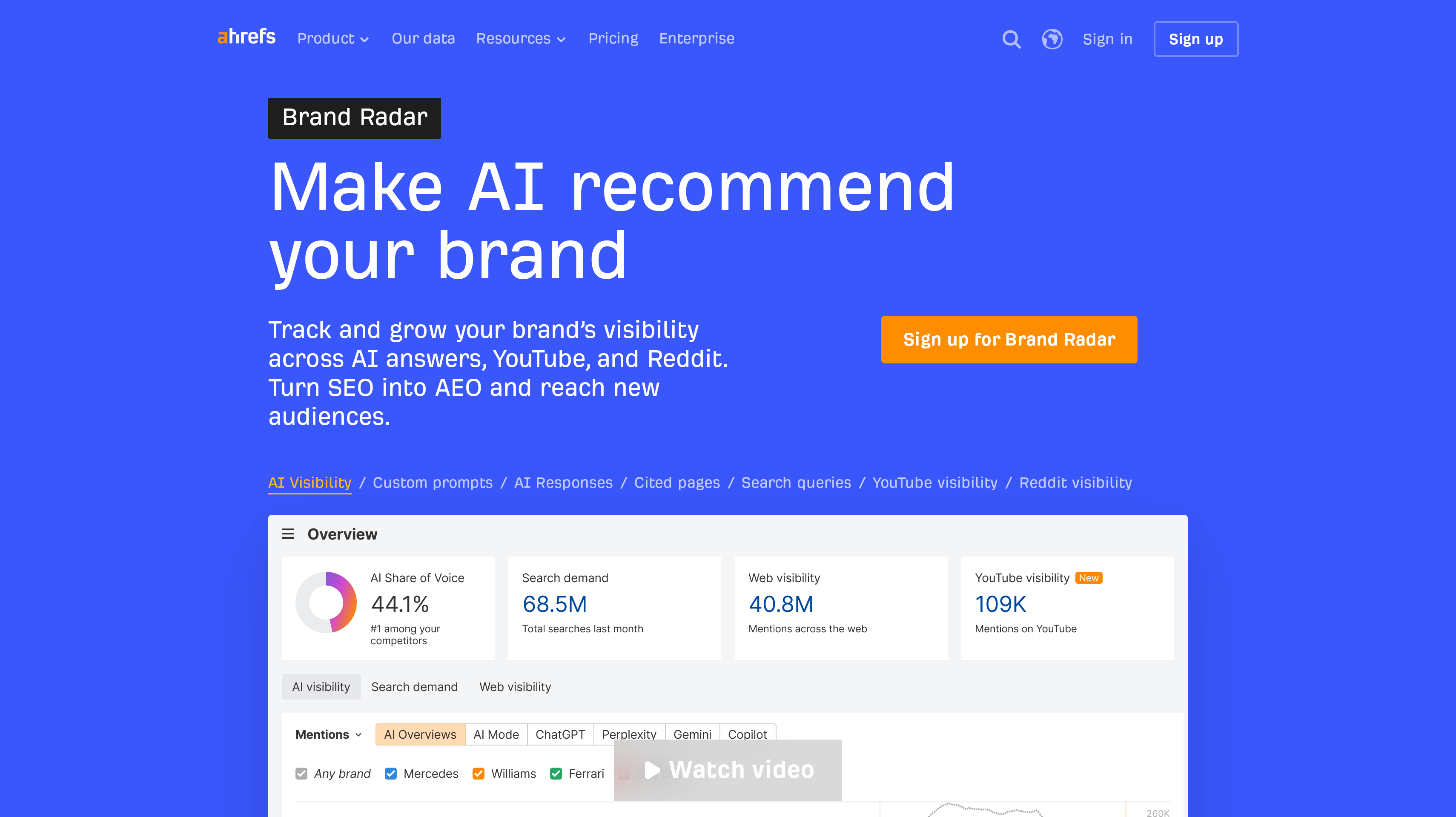
Ahrefs Brand Radar offers two ways to study AI visibility. Custom Prompts monitors the exact questions your buyers ask, even when nobody searches for your brand name yet. The AI Visibility Index lets you examine any brand against more than 495 million prompts modeled from real searches in Ahrefs' keyword database, with historical responses back to 2025.
The index suits category research once your brand already appears in AI search. You can compare AI share of voice, mentions, and cited pages alongside search demand and web visibility. YouTube and Reddit visibility add context about where a category appears beyond the answers themselves. Start with a competitor comparison to see which names and pages recur before building your own monitoring set.
Custom Prompts supports daily, weekly, or monthly updates per platform. Each prompt consumes one check for each platform, location, and update. That makes the schedule part of the buying decision. Your question count alone does not describe usage when you also want several countries and frequent updates.
Custom Prompts starts at $50 per month, with all models priced at $699 per month. Paid Ahrefs plans include a daily Custom Prompts quota of five on Lite, ten on Standard, and twenty on Advanced. The AI Visibility Index is $199 per month. Platforms include AI Overviews, AI Mode, ChatGPT, Perplexity, Gemini, and Copilot; Custom Prompts also supports Claude.
Best suited for marketing teams that want to benchmark an established category before choosing a focused tracking set. The large index and custom questions support separate research and ongoing monitoring jobs.
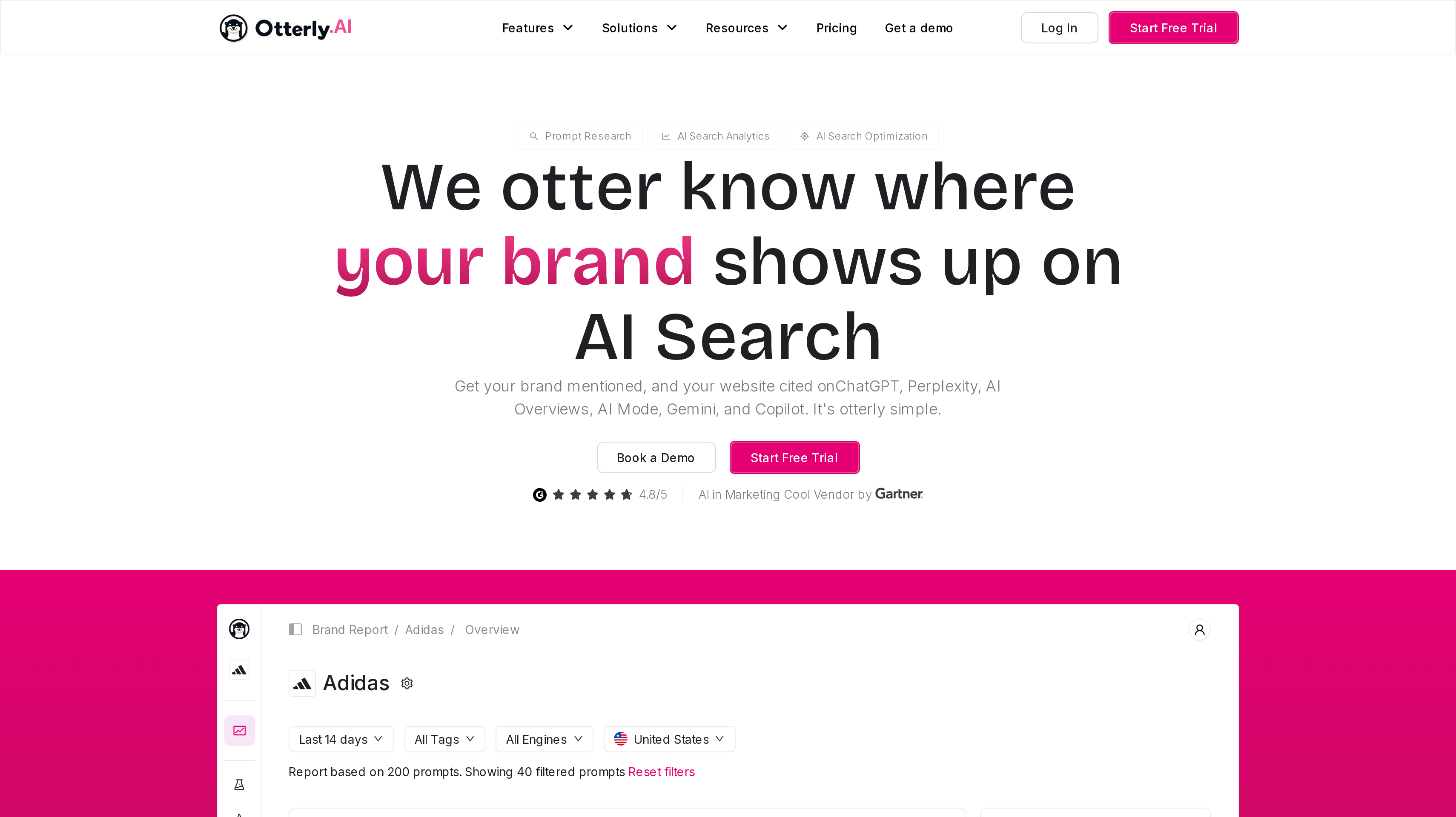
5. Otterly.AI, best for a low-cost start with GEO audits included
Otterly.AI tracks brand mentions and website citations, then adds audits and recommendations. Visibility and sentiment analysis, share of voice, brand profiling, and citation source tracking help you understand the answers. Its prompt research and query fan-out tools help you explore the questions behind a category, while crawlability audits and content checks give your team work to investigate on the website.
Lite is $29 per month on monthly billing for 15 search prompts, daily tracking, one workspace, and unlimited team members. It includes ChatGPT, Google AI Overviews, Perplexity, and Microsoft Copilot. Claude, Google AI Mode, and Gemini are add-ons. Lite also includes three recommendations per week and 1,000 GEO audits per month, making the entry plan useful for a small initial question set.
Standard costs $189 per month for 100 prompts and adds API access, MCP access, Agent Analytics, unlimited workspaces, and unlimited recommendations. Premium is $489 per month for 400 prompts. An extra 100 prompts costs $99, and Enterprise starts from 1,000 prompts with custom pricing and SSO. Annual billing is 15% off, and a seven-day free trial is available.
For a small SaaS team, start with the purchase questions you most want to understand, then use the cited sources and audit findings to assign work. A narrow, relevant prompt set gives the person reviewing the report something specific to improve. Standard adds operational access when those findings need to move into other tools.
Best suited for founders and lean marketing teams that want to start monitoring with website audits in the same subscription. The Lite allowance fits a focused pilot around a product category or a small group of buying questions.
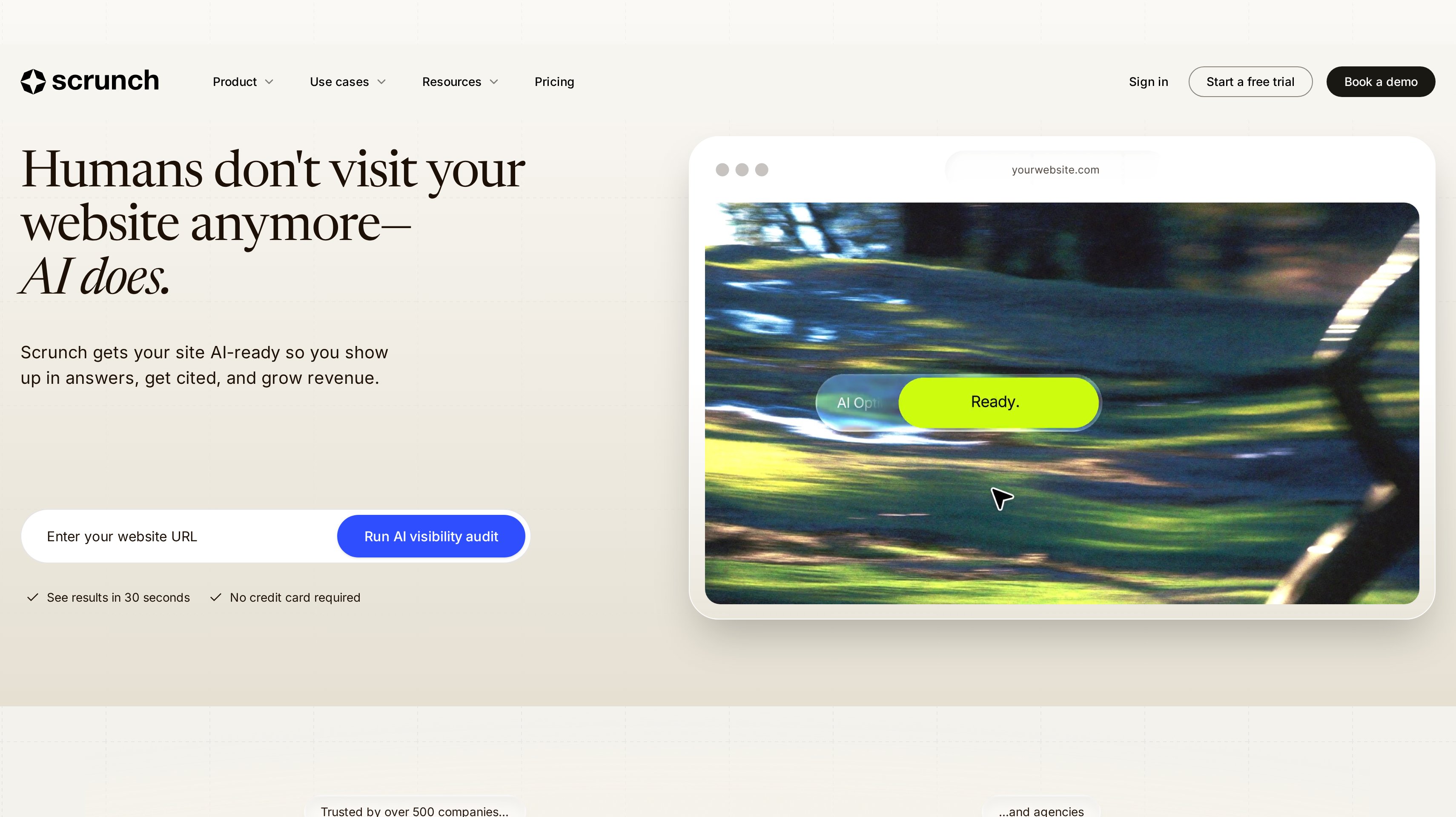
6. Scrunch, best for making your website readable for AI agents
Scrunch connects AI visibility monitoring with the website experience AI agents receive. Monitoring & Citations and Insights show how your brand appears, while Agent Traffic analyzes AI website visits. Site Optimization and site audits address the pages those systems encounter. The focus suits a team that wants its web developers involved alongside marketing.
Its Agent Pages and Agent Experience Platform, or AXP, deliver an optimized, token-light version of your website to AI agents without changing the human experience. That is a distinct implementation decision from editing a comparison page or tracking another prompt. You are deciding how agents receive your product information, so bring the person who owns the site into the evaluation.
Core costs $250 per month on monthly billing. It includes 125 unique prompts, 5,000 responses per month, five site audits per month, one brand workspace, and five user licenses. The four included models are ChatGPT, Perplexity, Google AI Overviews, and Copilot. A seven-day free trial lets you evaluate Core, and the homepage also offers a free AI visibility audit without a credit card.
Enterprise has custom pricing and adds AXP, complete site audits, API access and integrations, SSO through SAML or OIDC, and a dedicated account team. Its nine-model coverage includes Claude, Gemini, Meta AI, Google AI Mode, and Grok alongside the Core engines. Scrunch also lists Shopping and AI Search Trends products, with separate agency pricing available.
Best suited for teams that want to investigate agent traffic and adapt how their website serves AI systems. Enterprise AXP fits an evaluation where marketing and engineering share responsibility for the site's AI experience.
7. AthenaHQ, best for content optimization across many AI models
AthenaHQ combines cross-platform visibility tracking with a content optimization agent. Prompt and response analysis, competitor insights, and citation sources help explain what AI systems say about your business. It also detects missing or misunderstood business information, then recommends on-page and off-page actions. This fits a content team that wants the diagnosis and proposed work together.
Essential is free, with $25 in free credit covering 300 credits. It includes ChatGPT, Perplexity, AI Overviews, Gemini, Copilot, unlimited users, and the Athena AI agent. A separate free audit offer is available on the homepage. The credit allowance gives your team a way to try the reporting and agent before choosing a paid subscription.
Starter costs $295 per month on monthly billing and includes 3,600 credits, with one credit equal to one AI response. Coverage spans eleven models, including ChatGPT, Perplexity, AI Overviews, AI Mode, Gemini, Claude, Copilot, Grok, DeepSeek, Meta AI, and Mistral. Topics, prompts, and competitors are unlimited, while the response budget determines how much monitoring you run.
Country-level support and CSV export are included on Starter. API access and extra credits are paid add-ons. Enterprise pricing is custom and adds SSO, an audit log, multi-region and multi-language support, and BI dashboards for Tableau, Power BI, and Looker. Annual billing is 17% off. When sizing a plan, decide how frequently each topic needs another response before expanding your prompt list.
Best suited for content teams that want recommendations and an optimization agent alongside broad model coverage. Response-based capacity supports a workflow organized around the topics and markets your writers need to address.
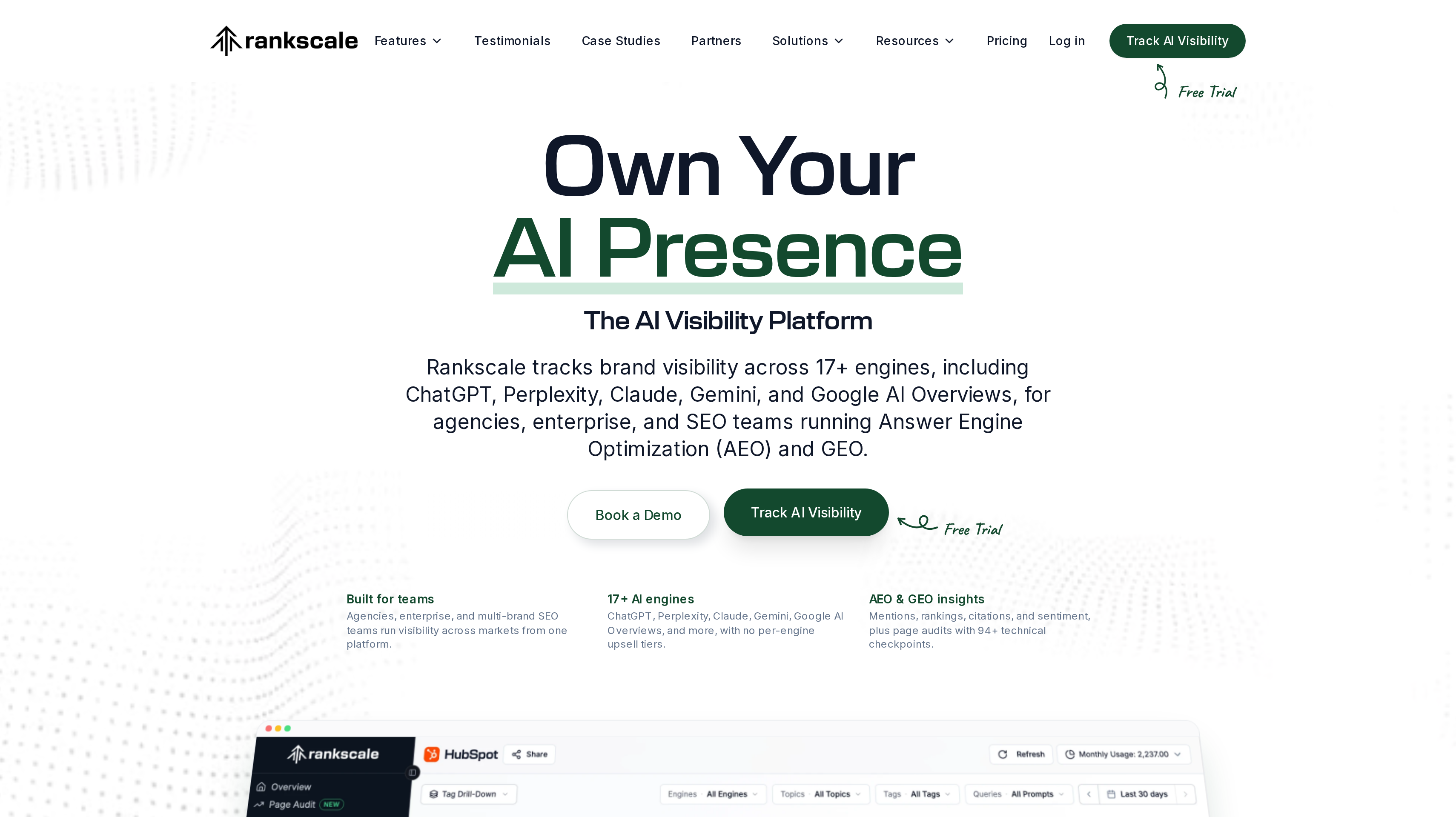
8. Rankscale, best for agencies and multi-brand tracking on credits
Rankscale is an AI visibility platform for agencies, enterprise teams, and marketers handling several brands. It tracks mentions, rankings, citations, and sentiment across more than seventeen engines without per-engine upsell tiers. Coverage includes ChatGPT, Perplexity, Claude, Gemini, Google AI Overviews, AI Mode, Copilot, DeepSeek, and Meta Muse Spark.
Page audits cover more than 94 technical checkpoints, and competitor auto-identification helps establish the comparison set. AI shopping visibility extends the reporting to shopping experiences. GA4 and Search Console connections are in beta. These capabilities let an agency investigate answers and technical pages within a workflow built around separate brand dashboards.
Monthly pricing is in euros. Pro costs €99 for 1,200 credits per month, up to 4,800 AI answers, ten brand dashboards, fifty page audits, and Looker Studio dashboards. Pro+ is €229 for 3,000 credits, twenty-five dashboards, one hundred page audits, and REST API access. Growth is €385 for 5,500 credits, fifty dashboards, two hundred page audits, white-label options, and agency benefits.
Enterprise costs €780 per month for 12,000 credits and one hundred dashboards. Custom plans are available, annual billing is 15% off, and Pro has a seven-day free trial. Keep credits and the published maximum answer allowance separate when budgeting. An agency should first map clients to dashboards, then decide which prompts and page audits each account needs during the month.
Best suited for agencies and multi-brand teams that want engine coverage and client dashboards under a credit-based subscription. Growth adds white-label reporting for teams presenting the work under their own agency brand.
Side-by-Side Comparison
Compare entry capacity with the engines you want to monitor and the work your team owns. Prices below use monthly billing in USD, except Rankscale in EUR; free access and quoted paid plans are identified separately. The tracking and engine cells describe entry access, while the profiles explain higher tiers.
Tool
Starting price
Prompt tracking
Engine scope
Best for
Peec AI
Starter $95/mo
50 daily
3 chosen
Marketing teams
Profound
Free trial; paid custom
50 daily in trial
3 in trial
Enterprise agents
Semrush Toolkit
$99/mo
Daily prompts
ChatGPT, AI Mode
Existing SEO users
Ahrefs Brand Radar
Custom Prompts $50/mo
Checks by schedule
By selection
Category research
Otterly.AI
Lite $29/mo
15 daily
4; add-ons
Low-cost audits
Scrunch
Core $250/mo
125 unique
4 on Core
AI-ready sites
AthenaHQ
Essential free
300 credits
5 on Essential
Content actions
Rankscale
Pro €99/mo
1,200 credits
17+
Multiple brands
Which AI visibility tool fits your use case
Choose around who will open the report and make the next change. A content lead looking for missing product explanations needs different support from an agency delivering reports for several clients. Both need useful questions, but their daily work differs.
Start your evaluation with a shared prompt set and a clear owner for the findings. Include a category question, a comparison, and a requirement that matters to your customers. Keep the same questions and model selection when comparing results, then inspect the actual answer and cited page behind a score.
Use case
What changes about the setup
What to look for
SaaS marketing team
Content and growth share reporting
Peec AI, daily prompts and source gaps
Enterprise execution
Research leads to approved drafts
Profound, agents and brand context
Existing SEO process
AI reporting joins current tools
Semrush, toolkit or SEO bundle
Category benchmarking
You need a broad competitor view
Ahrefs, index plus custom prompts
Small initial budget
A focused pilot needs practical tasks
Otterly.AI, entry tracking and audits
Website or content work
Developers or writers own changes
Scrunch for agent pages; AthenaHQ for content
Agency client reporting
Brands need separate dashboards
Rankscale, credits and white-label options
Proof: What results look like
Profound's customer story reports a 50% increase in Plaid's AI search visibility while saving time with Profound Agents, attributed to Hannah Hughes, Plaid's CMO. Otterly.AI publishes a quote from a content marketing manager at Instant Commerce reporting a 2x increase in both AI search visibility and incoming traffic. These are vendor-published customer results, with different measures and starting points.
For your own evaluation, keep visibility, citations, visits, and paid customers separate. Record the questions and engines behind a result so your team knows what changed. A better answer about a product requirement is useful evidence, but you still need your acquisition reporting to understand the business outcome.
Partner-channel results measure something else. In Affonso's published testimonials, Jonathan Wilke of supastarter says affiliates refer more than 50% of its customers, while SocialRails reports setting up in thirty minutes and receiving eight leads. Those results describe partner acquisition, not AI rankings. See the customer testimonials, then use the affiliate commission calculator to plan a reward your margins can support.
FAQ
What are the best AI visibility tools for SaaS teams?
Peec AI ranks first here for daily prompt tracking, source analysis, and unlimited users at a published monthly price. Profound suits enterprise teams combining measurement with agents, while Semrush fits an existing SEO workflow. Choose the platform whose reports lead to work your team can actually assign, whether that is a content update, a source investigation, or a technical audit.
How much do AI visibility tools cost?
Otterly.AI Lite is $29 per month, Peec AI Starter is $95, and the standalone Semrush toolkit is $99. AthenaHQ Essential is free with 300 credits, while its paid Starter plan is $295 per month. Rankscale Pro costs €99 per month; compare its credits with your planned dashboard and monitoring usage rather than treating them as prompts.
How do prompt tracking and a prompt index differ?
Custom tracking follows questions you choose on a defined schedule. An index lets you search an existing collection of questions and answers, which helps with category research but may cover different questions from your sales process. Ahrefs Brand Radar offers both, so decide whether you need a broad benchmark, ongoing measurement of specific buyer questions, or both jobs together.
Which tools cover ChatGPT, Perplexity, Gemini, Copilot, Claude, and Google AI search?
Check the individual plan's model selection before subscribing. Peec offers up to thirteen models on Enterprise, Profound up to nine answer engines, AthenaHQ Starter eleven models, and Rankscale more than seventeen engines. Otterly.AI Lite includes four engines, with Claude, Gemini, and Google AI Mode available as add-ons, so vendor-wide coverage alone does not describe the entry subscription.
How should I choose prompts for a software company?
Start with the questions a buyer asks before a demo or signup, including category discovery, product comparisons, and required integrations. Keep branded questions separate from questions where the buyer has not chosen a vendor yet. Group the set by buying intent and market, then review the actual responses so an incorrect product description does not disappear inside an average score.
Can these tools tell me which pages to improve?
Source analysis identifies cited pages, while audits and recommendations help you investigate possible changes. Peec includes source classification and gap analysis, Otterly.AI adds crawlability and content checks, and AthenaHQ provides content recommendations and an optimization agent. Assign an owner to the page or source involved, and track that work separately from the visibility report so recommendations reach your publishing process.
What should I compare when looking for Profound or Peec AI alternatives?
Write down the workflow you want to keep first. Peec centers on prompt analytics and source insights, while Profound also offers an AI Marketer and Agent Analytics. Compare the required engines, monitoring frequency, exports, and execution tools, then calculate capacity for your actual setup instead of choosing by the lowest advertised subscription or the largest vendor-wide model count.
How can affiliate and partner programs support this work?
Creators, customers, and agencies can publish reviews, comparisons, and tutorials that become third-party sources about your product. Affonso lets you run affiliate and partner programs around that publishing and attribute the referrals it brings to your business. Compare saas affiliate software or use the affiliate software shortlist to plan that channel alongside your visibility work.
Try for free
Choose the visibility platform that fits your team's next task. Build a prompt set around real buying decisions. Give each finding an owner and a page or source to investigate. When customers and creators publish useful content about your product, give them a clear partner offer. Track the referrals that work brings to your business. Start your Affonso free trial.
 Affonso
 Silvestro Zinnanti, FounderComparisonOctober 21, 202622 min read