Compare eight AI SEO tools for SaaS, app, and plugin teams. See pricing, free trials, content briefs, AI writing, on-page optimization, and the fit for your team.
Your content backlog grows every time someone finds a new keyword. Meanwhile, older posts need updates, briefs take an afternoon, and the draft still needs someone who understands your product.
AI can take on parts of that work. The useful buying question is which part your team needs help with first, and how the output gets into your publishing process.
This shortlist covers the best AI SEO tools for SaaS, app, and plugin companies. Surfer ranks first for content optimization, with a Content Editor and Content Score that turn a page review into specific edits.
Key Takeaways
The short version, before you compare the tools.
Surfer leads for editing and refreshing content. Its Content Editor gives writers live guidelines and a Content Score, while audits identify gaps in existing pages. Discovery starts at $49 per month billed yearly for one team seat and 120 documents.
Clearscope makes collaboration a clear buying decision. Every plan includes unlimited users and projects, alongside research, AI drafting, and term suggestions. Essentials is $129 per month on monthly billing, with a 14-day free trial.
A complete writing workflow differs from an optimization editor. Frase carries research into briefs, drafts, optimization, and CMS publishing. NeuronWriter starts at $23 per month on monthly billing for teams that mainly need competitor analysis and NLP term recommendations.
Choose strategy software when the backlog itself is the problem. MarketMuse uses your content inventory and existing authority to suggest topic clusters and priorities. Search Atlas fits agencies and multi-site teams that also want AI content production and automated on-page fixes.
Brand consistency and publishing volume are separate jobs. Jasper gives marketing teams shared brand knowledge and writing agents. Outrank generates and publishes a daily article from a content plan, with 30 articles per month on its Organic Growth Plan.
Compare the allowance you will actually use. Documents, articles, credits, seats, sites, and briefs measure different work. A tool that fits your editor may still need a higher plan for the people or publishing volume behind that editor.
What AI SEO tools actually are (and what they are not)
AI SEO tools help you decide what to write, turn research into a brief, produce a draft, and improve the page before or after publication. Some concentrate on comparing your content with competing pages. Others manage the whole path through publishing. The common job is helping a content team produce useful pages for Google search and AI answers without adding the same amount of manual research to every assignment.
For a SaaS company, the work starts with a buyer's problem and ends with a page that explains it accurately. A category comparison needs different evidence from an integration tutorial or a product alternative page. Software can suggest terms and structure, but your team supplies product knowledge, examples, and the reason a reader should trust the answer. That editorial input matters just as much for a plugin with a narrow use case as for a broad app platform.
AI visibility trackers, rank trackers, and link building tools are separate categories. An editor's score describes its assessment of the page, rather than promising a ranking or citation. Your content process still needs someone to confirm claims, match search intent, and keep screenshots and instructions current when the product changes.
Set the business goal before choosing a writing allowance. Use the free LTV:CAC analyzer to think through what customer acquisition can cost, then decide which content work deserves your budget. A weekly publishing target is useful only when those pages help the right buyers understand your product and take the next step.
How We Ranked These AI SEO Tools
This shortlist focuses on the content work inside a SaaS, app, or plugin company. The order favors tools that help your team research, brief, write, optimize, and refresh pages, with a distinct pick for each buying situation.
The comparison draws on public product pages, pricing, and vendor documentation.
We compared five criteria:
Research and briefing. Competitor content analysis, topic discovery, search intent, and the path from a keyword to an assignment a writer can use. A useful brief should leave room for your product's own examples.
Writing and editorial guidance. AI drafting, brand voice, term recommendations, and page scoring. The question is whether the tool helps an editor make a better decision about the page.
Content maintenance. Audits, inventory analysis, internal linking, and recommendations for existing pages. Refreshing a relevant article belongs in the same buying decision as producing a new one.
Team and publishing fit. Seats, projects, supported languages, CMS connections, and API or MCP access. These determine who can work in the tool and how a finished article reaches your site.
Cost and usable capacity. Entry prices, billing terms, trial access, and published allowances. We keep documents, generated articles, briefs, and credits separate because they are not interchangeable units.
Customer outcomes stay attributed to the vendor and person reporting them. Secondary tracking and backlink capabilities do not decide the order. We plan to review this guide quarterly and after material pricing changes.
The Best AI SEO Tools in 2026
Start with the task that keeps slipping in your content calendar. An editor with clear recommendations solves a different problem from a strategy platform or a service that publishes for you. These eight tools cover those choices, so you can build a shortlist around the work your team will actually hand over.
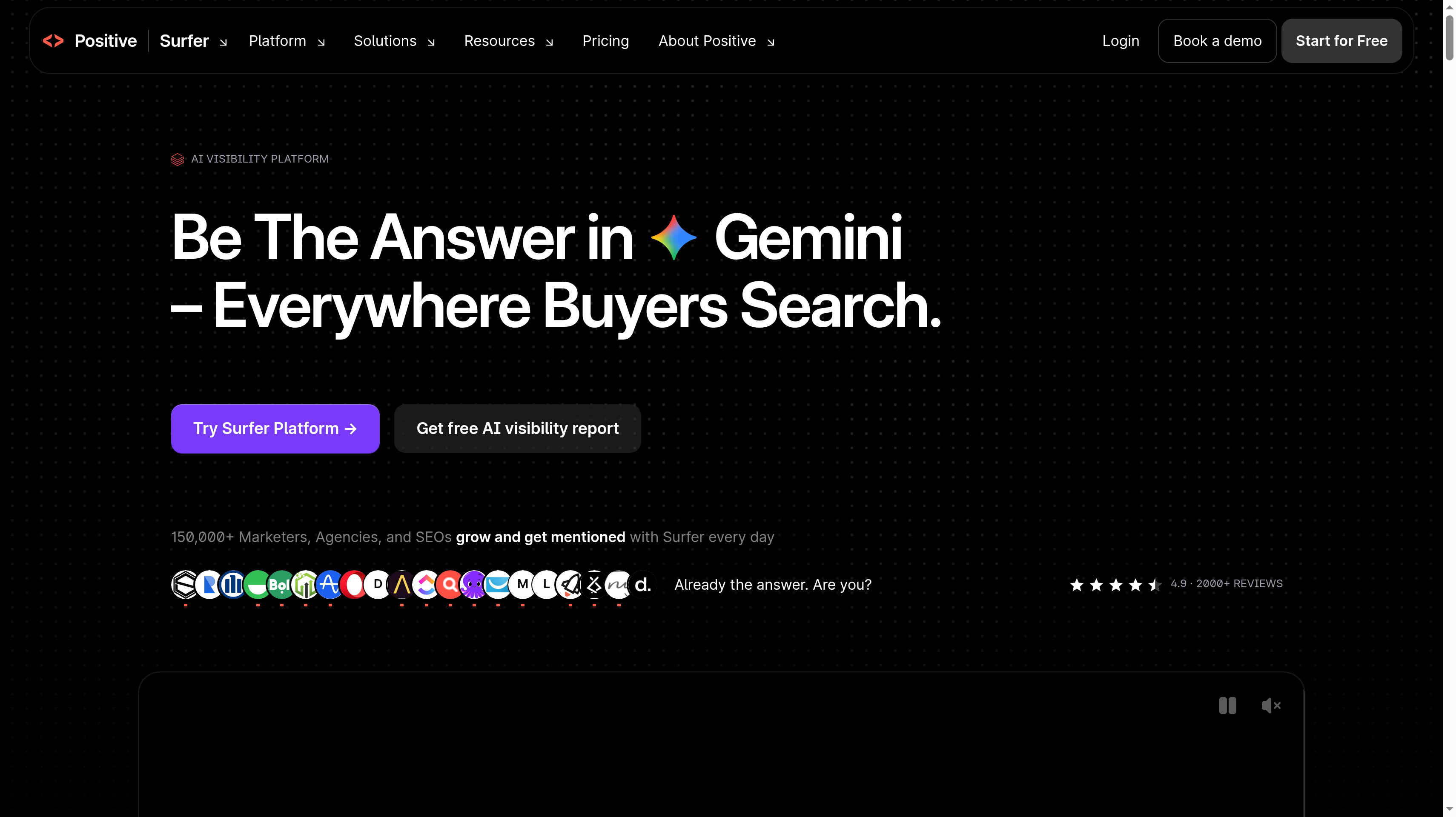
1. Surfer, best overall for AI content optimization
Surfer puts its Content Editor and Content Score at the center of the writing process. Writers get live guidelines while they work, and the audit workflow finds competitive gaps in existing content and turns them into a prioritized action list. That direct connection between a page and the edits it needs is why Surfer leads this shortlist. It fits a team improving an established blog as well as one setting an editorial standard for new posts.
Discovery is $49 per month billed yearly, with 120 documents, ten tracked pages, and one seat. Standard is $99 per month billed yearly, with 360 documents, three seats, and 50 tracked pages. Pro is $182 per month billed yearly, with 360 documents and five seats. Peace of Mind is $299 per month billed yearly, with unlimited documents, ten seats, API access, and a dedicated success manager. Every plan has a Start for Free option.
Surfy helps with writing, while topical maps, keyword research, and the SERP analyzer support planning. One-click content optimization offers another route into page updates. Pro adds internal linking, content ideas and coverage gaps, custom voices, the cannibalization report, and MCP access.
The WordPress plugin includes the full Content Editor, so a writer can optimize a product comparison inside your publishing environment.
Best suited for content teams that want specific guidance while editing new articles and refreshing existing pages. Its live recommendations give an editor a shared basis for deciding which changes to make before publication.
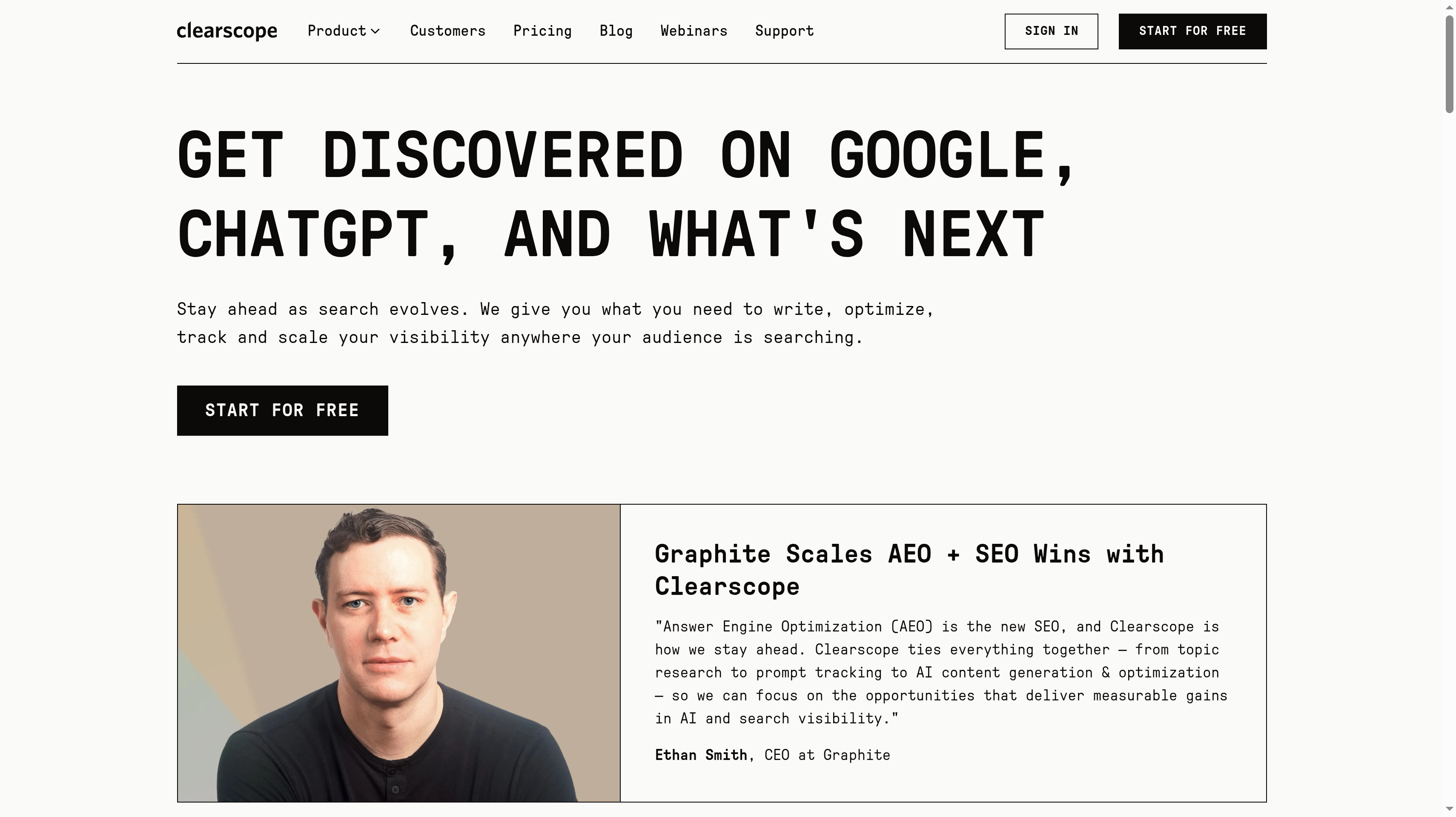
2. Clearscope, best for clear term guidance with unlimited users
Clearscope combines content research, AI drafting, and editing with term suggestions. Search intent analysis helps you decide what an article needs to answer, and Query Discovery finds queries that drive traffic across Google and AI assistants. The buying distinction for a shared editorial operation is unlimited users and unlimited projects on every plan. Your writer, editor, and product specialist can all take part without making each additional participant a seat purchase.
Essentials is $129 per month on monthly billing, with 50 tracked queries, 50 pages, 20 monthly topic explorations, and 20 monthly drafts. Business is $399 per month on monthly billing, with 300 tracked queries, 300 pages, 50 topic explorations, 20 drafts, and a dedicated account manager. Enterprise has custom pricing and adds SSO and custom credits. There are no contracts, and a 14-day free trial gives your team a way to evaluate the workflow.
Content monitoring watches published pages to help protect rankings, and internal linking connects related work. Localization supports teams adapting content for other markets. Query Tracking in ChatGPT and Gemini is also included, though the research and editing workflow is the reason for its position here.
Priority support, live onboarding, and training come with every plan, so your contributors can learn the editing workflow together.
Best suited for content teams that want writers and subject experts working from the same clear recommendations. Unlimited users and projects fit an editorial process with contributors across departments or external writing partners.
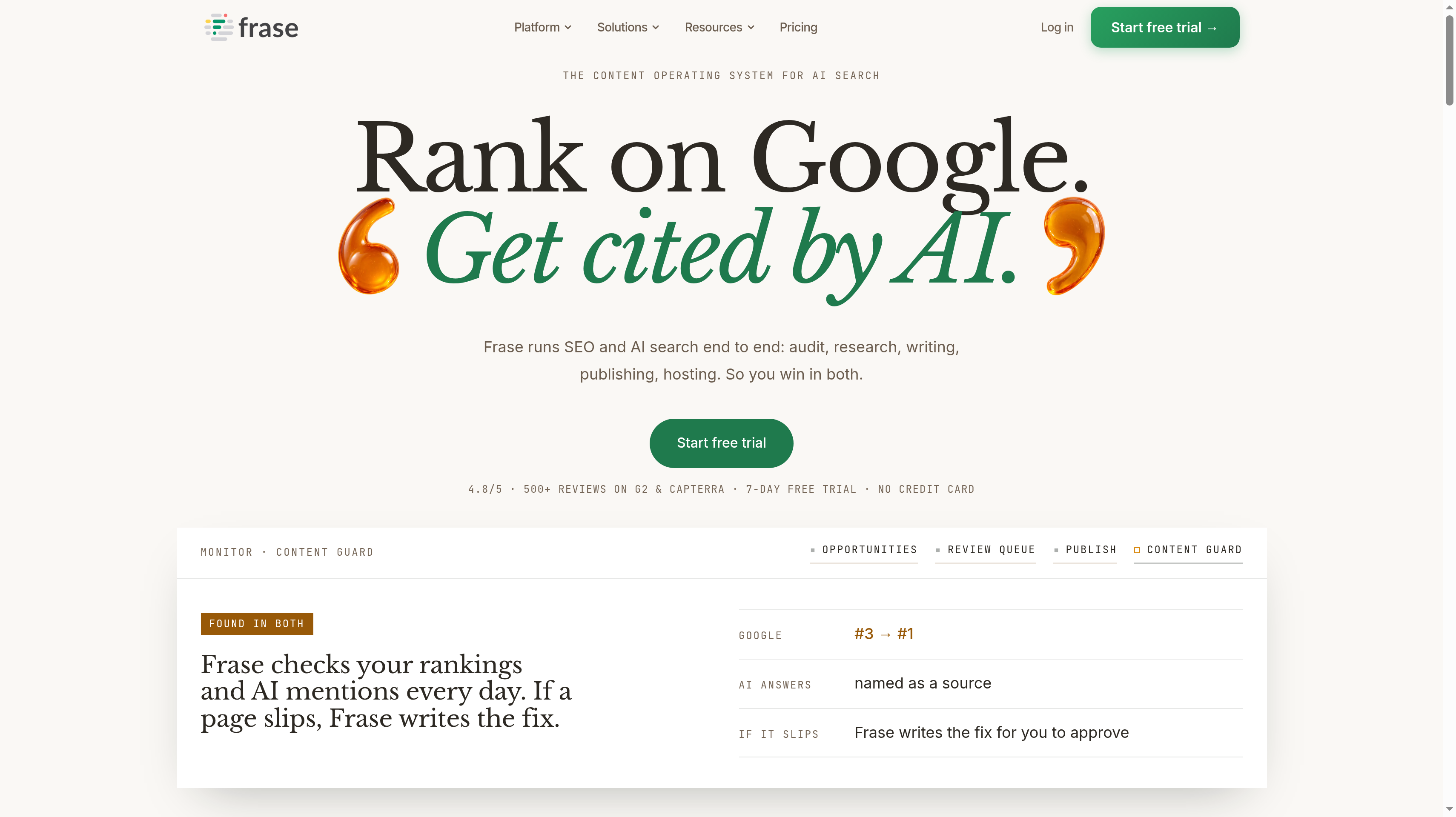
3. Frase, best for research, writing, and publishing in one workflow
Frase connects a site audit to research, briefs, drafting, optimization, and publication. Its audit scores pages for search and AI answers, while topic clusters help organize what to cover next. Research ends in a brief that an AI drafting agent can use with your brand voice. SEO and GEO scores then guide optimization. That sequence suits a small content operation where the same person is responsible for both the assignment and getting it live.
Starter costs $49 per month on monthly billing or $39 per month billed yearly. It includes one seat, one site, ten articles, and 50 audit pages per month. Professional is $129 per month on monthly billing or $103 billed yearly, with three seats, five sites, 40 articles, 250 audit pages, a content calendar, and internal linking suggestions. Scale is $299 per month on monthly billing or $239 billed yearly, with five seats, up to ten domains, 100 articles, 1,000 audit pages, and client-ready reports.
Publishing supports WordPress, Webflow, Sanity, Wix, and FraseCMS. Frase writes natively in more than 70 languages, and its MCP server, CLI, and API give technical teams additional ways to run the workflow. Content Guard watches pages for ranking decay so updates can return to the queue.
The seven-day free trial requires no credit card. Starter stops at its monthly limits, which gives a lean team a defined allowance for its first publishing schedule.
Best suited for small teams that want research and drafting to lead directly into CMS publishing. It gives the person running a weekly content calendar one connected process for new articles and page refreshes.
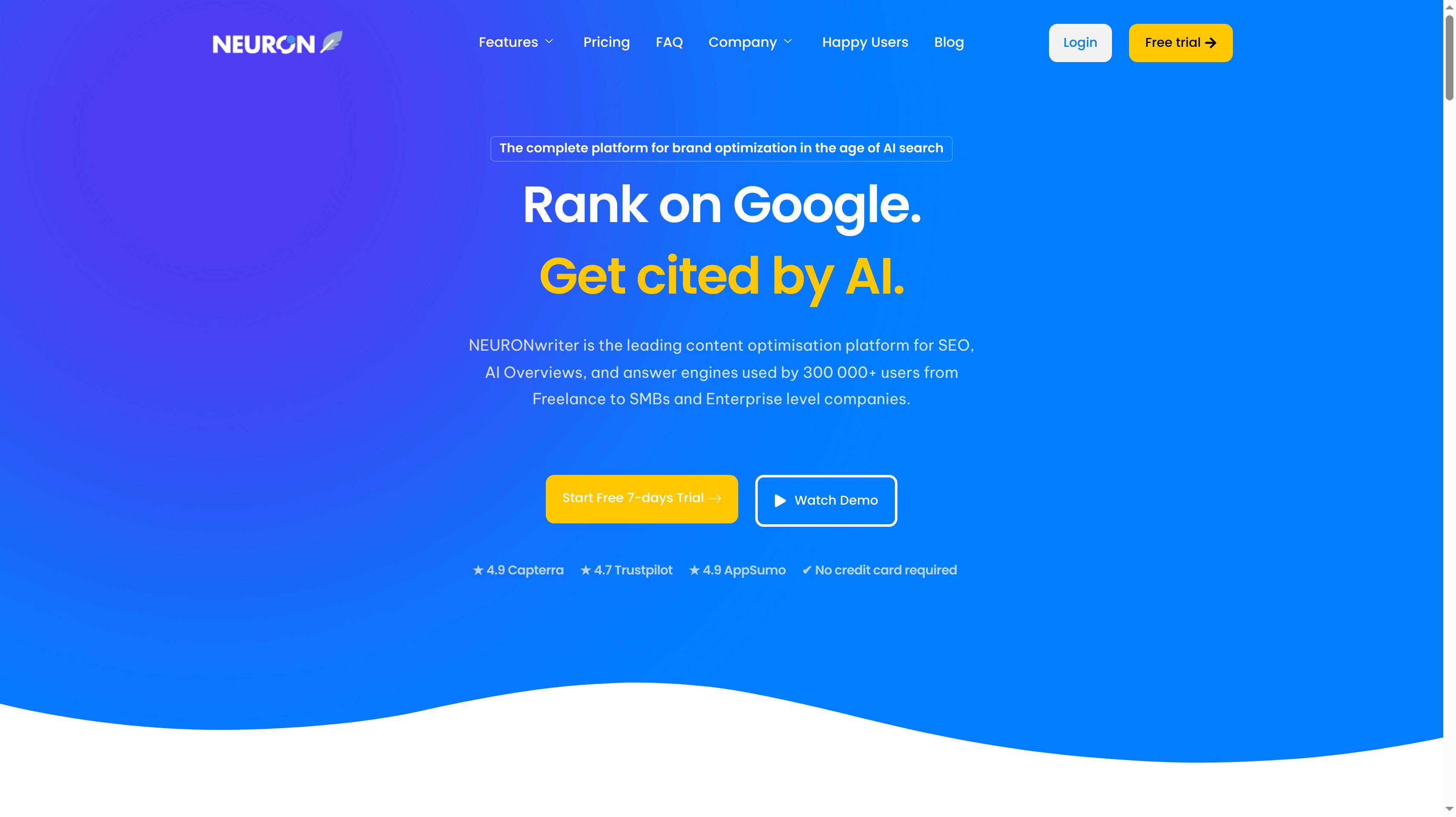
4. NeuronWriter, best for a budget content editor with NLP guidance
NeuronWriter analyzes top-ranking competitor content and recommends NLP terms for your article. It also suggests titles and meta descriptions, generates outlines and drafts, and includes a content planner. The appeal is a low entry price for a recognizable editing job. You can take a planned SaaS tutorial or category article, compare its coverage with competing pages, and decide where the draft needs a clearer or fuller explanation.
Bronze is $23 per month on monthly billing, with two projects, 25 documents, and 15,000 AI credits. Silver is $45 per month on monthly billing, with five projects and 50 documents. Gold is $69 per month on monthly billing, with ten projects, 75 documents, unlimited team members, Content Designer, custom AI templates, and support for your own OpenAI key. The seven-day trial requires no credit card.
Gold and higher plans include plagiarism checks, Google Search Console, WordPress and Shopify integrations, and API and MCP access. Internal linking suggestions support the editorial workflow. These plan boundaries let you distinguish a single writer's document allowance from the collaboration and publishing access a broader team needs.
Platinum is $93 per month on monthly billing for 25 projects and 100 documents. Diamond is $117 per month on monthly billing for 50 projects and 150 documents. Those tiers increase capacity when you manage several product sites or a larger queue of updates.
Best suited for founders and lean content teams that want competitor-based term guidance at a modest starting cost. Gold fits a shared editing workflow where team access and CMS connections matter alongside the document allowance.
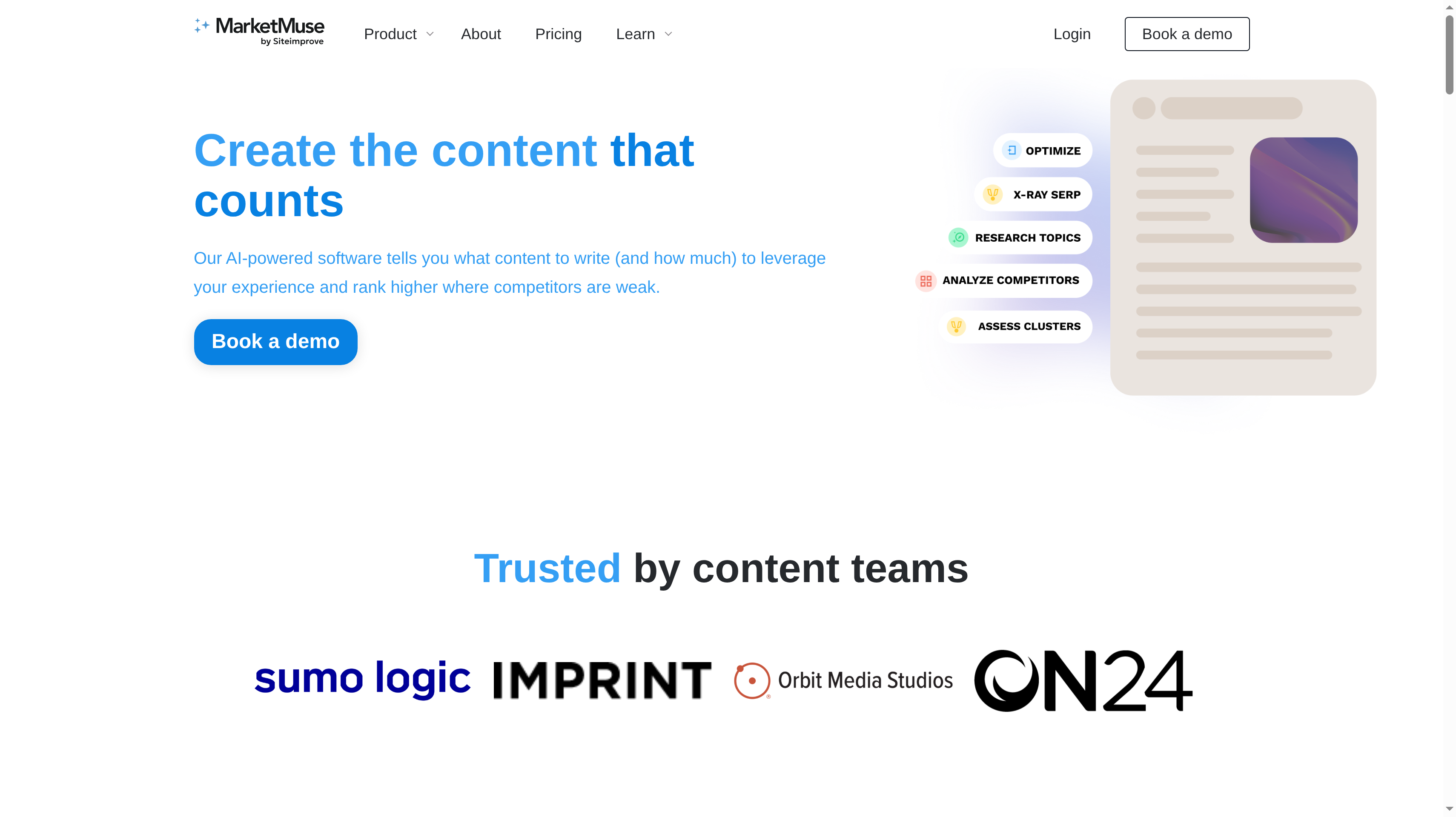
5. MarketMuse, best for content strategy and topical authority planning
MarketMuse starts with your entire content inventory. Its AI finds topic clusters and quick wins based on the authority your site already has, then shows where competitors cover subjects you have missed. Personalized difficulty helps you judge which topics are easier for your own site to rank for. This is the strategy choice when the hard part is deciding which articles deserve a place in the backlog.
The Free plan includes one user and ten queries per month. Optimize covers one site inventory, one user, 100 tracked topics, five content briefs, and one strategy document per month. Research includes three users, 1,000 tracked topics, ten briefs, three strategy documents, and unlimited queries. Strategy includes five users, 10,000 tracked topics, 20 briefs, all nine brief types, and five strategy documents. Optimize, Research, and Strategy are available through a demo.
The content plan carries those priorities into assignments. Briefs and optimization recommendations address structure, expertise, and depth, while link recommendations help connect related pages. Quality analysis gives your editor another way to assess whether an article covers the subject well enough for its intended reader.
Best suited for content leads building a topic cluster around a product category or reorganizing a substantial article library. Its inventory analysis and personalized difficulty help turn a broad subject into a prioritized content plan.
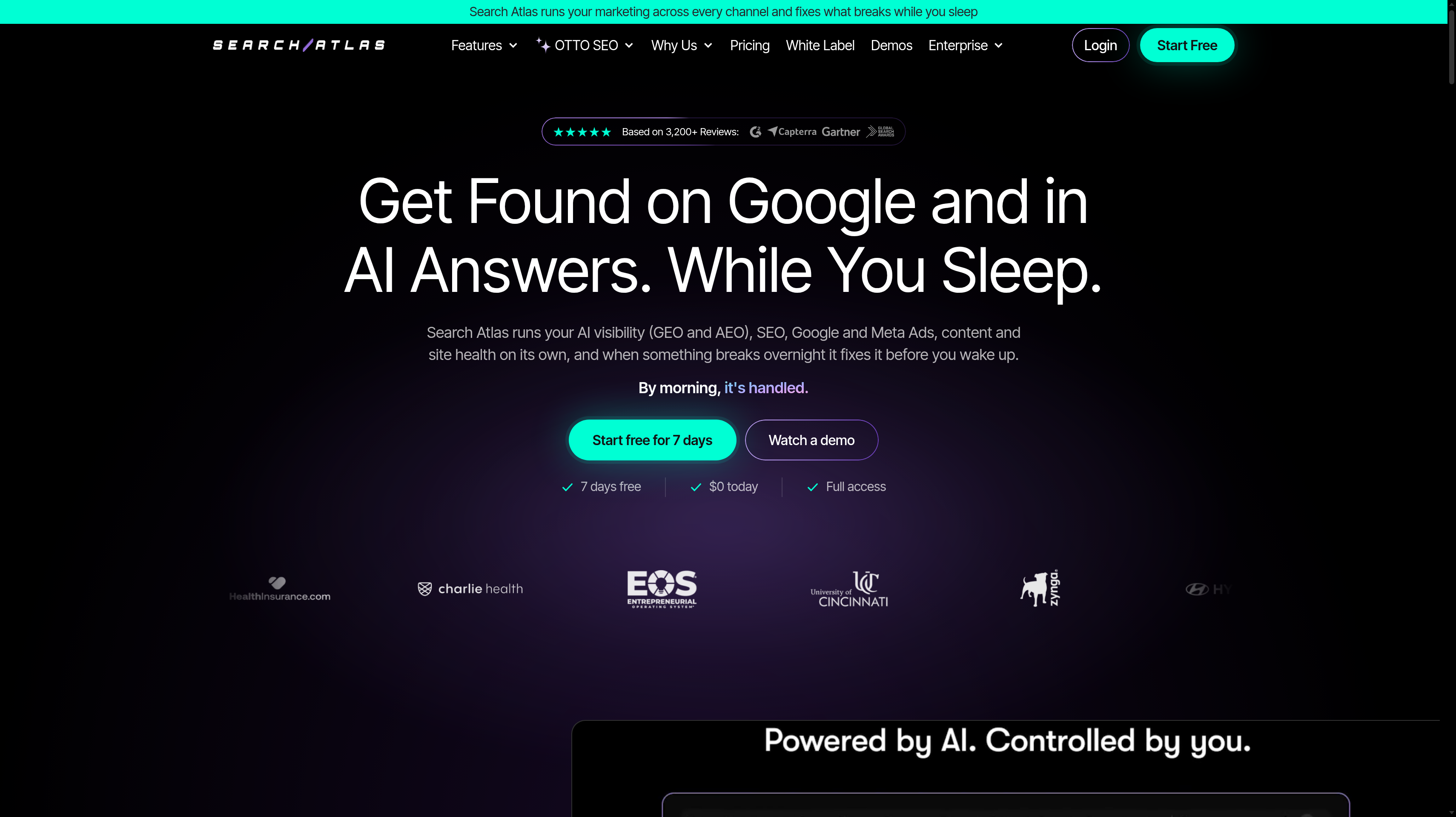
6. Search Atlas, best for AI SEO automation across client sites
Search Atlas combines an AI content suite with automation that acts on your site. OTTO SEO applies technical and on-page fixes, while Atlas Agent, Content Genius, and topical maps support content production and planning. Publishing to any CMS connects that work to the sites you manage. The reason to shortlist it here is the combination of content creation and implementation across an agency's or multi-site team's workload.
Starter is $99 per month billed monthly, with one project, one seat, one OTTO-powered site, and 50,000 universal credits. Growth is $199 per month billed monthly, with two projects, three seats, and two OTTO sites. Pro is $399 per month billed monthly, with four projects, five seats, white-label dashboards, and reporting. Agency starts at $999 per month billed monthly, with ten projects, ten seats, and client portals. A seven-day free trial is available.
The site auditor helps identify work alongside the content queue, and the report builder supports client reporting. When you compare plans, count the sites that need OTTO separately from the writers who need access. Universal credits are another unit to map against the tasks your team expects to run.
Keyword tracking, local SEO, link building, press release tools, and LLM visibility on Growth and above are secondary capabilities alongside the content suite.
Best suited for agencies and multi-site teams that want AI content work and automated site changes in the same platform. Project capacity, OTTO site allowances, and client reporting give those teams concrete points to compare.
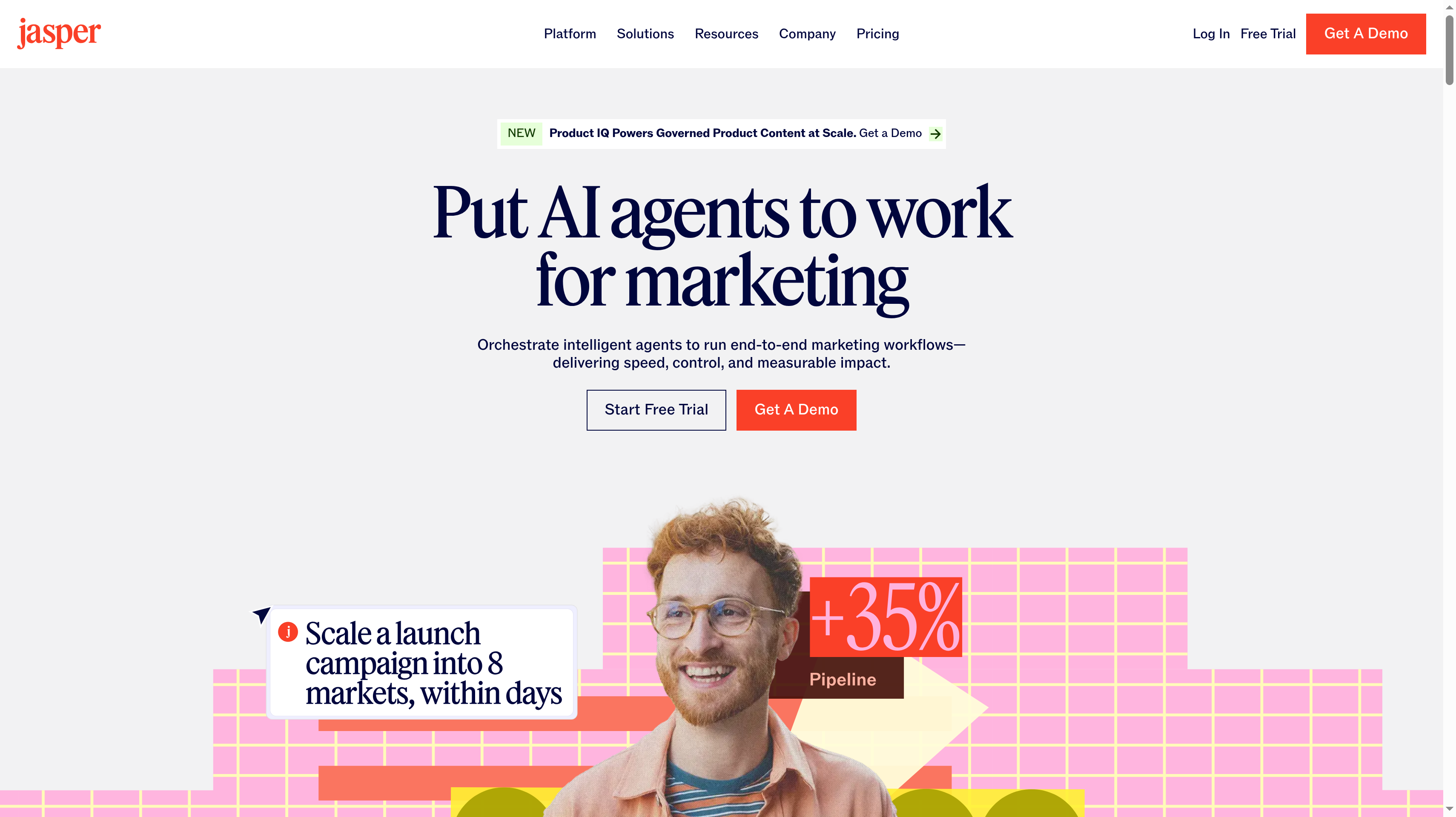
7. Jasper, best for on-brand AI writing across a marketing team
Jasper is an AI agent workspace for marketing teams, with more than 100 purpose-built marketing agents. Jasper IQ holds your brand voice, style guide, audiences, and company knowledge, while Canvas, Grid, and Studio support content pipelines. Its place in this shortlist comes from keeping writing aligned across people and channels. A SaaS team can bring the same product context into an SEO article and the other marketing copy that supports it.
Pro is $69 per seat per month on monthly billing or $59 per seat per month billed yearly. It includes one seat, two brand voices, five knowledge assets, three audiences, and agents for core marketing workflows. A seven-day Pro trial is available. Business has custom pricing with a 12-month commitment and adds GEO, translation, and deep research agents, no-code custom agents, Jasper Grid, API access, and SSO.
Jasper supports SEO and AEO content and writing in more than 30 languages. A browser extension and integrations including Webflow and Google Docs bring it into existing writing environments. Copyscape plagiarism checking is an add-on. For an editorial lead, the practical choice is how shared brand knowledge will guide each assignment before an editor reviews it.
Jasper is SOC 2 Type II compliant and says it never lets third parties train AI models on customer data. Those commitments give teams handling internal company knowledge specific policies to include in a buying review.
Best suited for marketing departments that need a consistent voice across SEO articles and other campaigns. Shared brand context helps multiple writers produce copy around the same product, audience, and company knowledge.
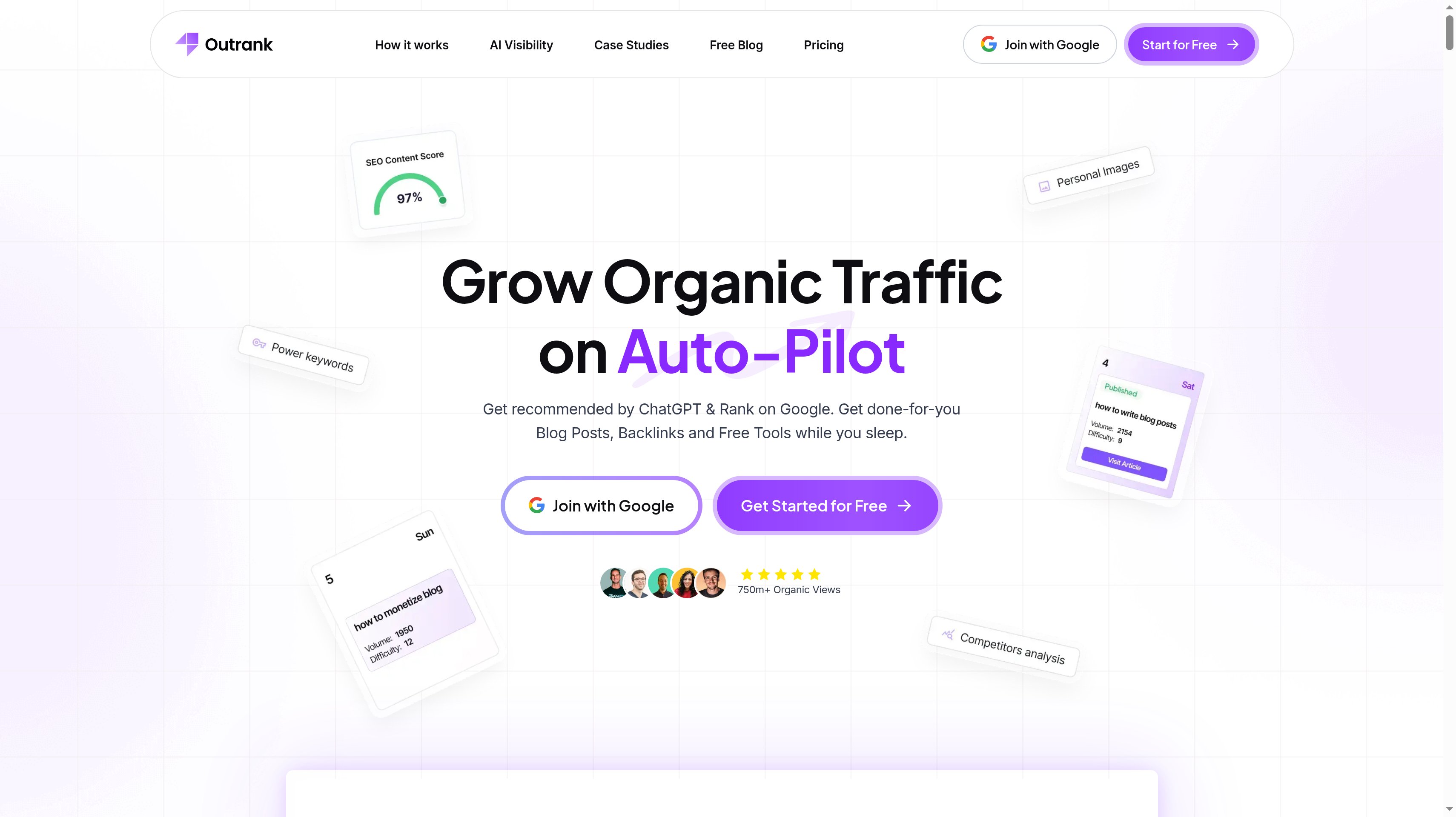
8. Outrank, best for hands-off blog publishing
Outrank builds a 30-day content plan from your niche and competitors, then generates and publishes one SEO-optimized article per day. Automated keyword research, AI images, and relevant YouTube videos are part of the process. It is the clearest fit here for a founder who wants to hand over routine blog production. Your main buying decision becomes the publishing schedule and how you will review what represents your product.
The Organic Growth Plan costs $99 per month on monthly billing or $999 per year, with 30 articles per month. Add-ons increase output to 60 articles per month for an additional $85 per month, or 90 articles for an additional $160 per month. A human-curated editing service costs $1,399 per month. You can cancel anytime, and volume discounts start at 10% for two to four sites.
Outrank supports articles in more than 150 languages, unlimited AI rewrites, and unlimited users. Integrations cover WordPress, Webflow, Shopify, Wix, Framer, Notion, Ghost, and a custom webhook. There is also a free blog option on your own domain. Those publishing destinations matter when your marketing site uses a different platform from the rest of your app.
Best suited for founders who want a regular blog publishing service with planning and article creation included. It gives a small business a defined monthly output while leaving room to choose an additional editing service.
Side-by-Side Comparison
Compare the content job first, then the people and output your subscription covers.
Tool
Starting paid price
Free plan or trial
Core job
Standout for SaaS teams
Surfer
Discovery $49 a month billed yearly
Start for Free option on every plan
Live content guidelines, Content Score, audits, and optimization
Discovery: 120 documents, 1 seat; full Content Editor in WordPress
Clearscope
Essentials $129 a month billed monthly
14-day trial
Content research, AI drafts, term suggestions, and page monitoring
Unlimited users and projects; Essentials includes 20 monthly drafts
Frase
Starter $49 monthly or $39 a month billed yearly
7-day trial, no card
Research, briefs, AI writing, optimization, and publishing
Starter: 10 articles a month; WordPress, Webflow, Sanity, and Wix publishing
NeuronWriter
Bronze $23 a month billed monthly
7-day trial, no card
Competitor analysis, NLP guidance, outlines, and drafts
Bronze: 25 documents; Gold adds unlimited team members and CMS integrations
MarketMuse
Optimize, price through a demo
Free: 1 user, 10 queries a month
Inventory analysis, topic strategy, briefs, and optimization
Personalized difficulty and content plans based on existing authority
Pro per seat: $69 monthly; $59 a month billed yearly
7-day Pro trial
Brand-guided AI writing and marketing agents
Shared brand voice and company knowledge; GEO agents on Business
Outrank
Organic Growth Plan $99 a month or $999 a year
Free blog option on your own domain
Automated content planning, generation, and daily publishing
30 articles a month, unlimited users and rewrites, broad CMS integrations
Which AI SEO tool fits your use case
Two companies with the same content budget can need different software. An established library creates a maintenance job, while an empty blog creates a production job. Start with the work your team cannot keep up with, then match the subscription to that work.
Use your next real assignment to evaluate a shortlist. Bring a page that needs updating, a product category that needs a plan, or a brief that keeps stalling before publication. That gives your editor something concrete to judge beyond a dashboard score.
Use case
What changes about the setup
What to look for
SaaS team optimizing existing blog posts
Your backlog contains published pages with outdated explanations or incomplete coverage.
Surfer for audit priorities and live editing guidelines; Clearscope for term guidance and ongoing content monitoring.
Lean team writing new posts every week
Research, briefing, drafting, and publishing fall to the same small group.
Frase for the connected workflow and CMS publishing; NeuronWriter for a lower-cost editor with outlines and drafts.
Agency or many client sites
Site allowances, team access, and reporting become recurring operational decisions.
Search Atlas for content automation, OTTO sites, and client reporting; compare project limits with your actual client workload.
Planning a topic cluster around a product category
You need to decide what to cover and how the existing library supports it.
MarketMuse for inventory analysis, personalized difficulty, competitor gaps, and a prioritized content plan.
On-brand content across many channels and writers
Different contributors need the same product knowledge and writing standards.
Jasper for brand voices, audiences, company knowledge, and marketing agents that support a shared content process.
Founder who wants a blog without writing it
Planning and routine production need an owner outside the founder's weekly workload.
Outrank for a 30-day plan and daily article publishing, with an optional human-curated editing service.
Proof: What results look like
Clearscope publishes that Omid Ghiam, Organic Growth Manager, grew non-branded SEO traffic on the Webflow blog by 130% in 2024. MarketMuse publishes a statement from Zoe Hawkins, Principal Content Manager at Sumo Logic, that pieces optimized with MarketMuse see 4x-10x more traffic. These are attributed customer outcomes, rather than a forecast for your own blog.
Surfer publishes ClickUp SEO Director Jeremy Galante's statement that it has quickly become essential in ClickUp's SEO workflow. That describes adoption inside a content process, a different kind of evidence from traffic growth. Choose a tool against the job you need it to do, then evaluate the pages your own team produces.
Partners can contribute to customer acquisition alongside your own content. Jonathan Wilke, founder of supastarter, reports that affiliates refer more than 50% of its customers. Affonso's customer stories cover that channel, and the growth simulator helps you model how it could contribute to your business.
FAQ
What are the best AI SEO tools for a SaaS company?
Surfer is our first pick for content optimization, while Clearscope suits teams that want clear term guidance and unlimited users. Frase fits a connected research-to-publishing process, and NeuronWriter offers a lower entry price for editing. Start with the task your team needs to improve, then compare the relevant article, document, and seat allowances.
Can AI-written content rank on Google?
AI can help produce content that answers a searcher's question, but a generated draft does not establish its accuracy or usefulness. Add product knowledge, verify claims, and give the reader a clear answer before publishing. Treat a tool's content score as editorial guidance rather than a promise that the page will rank or appear in AI answers.
What is the difference between AI SEO tools and AI visibility trackers?
The tools in this guide mainly help you create and improve content. AI visibility trackers measure whether a brand appears in answers across AI services, which is a separate measurement job. Some products bundle both, but buying writing software and buying a way to monitor brand mentions should begin with different requirements.
Which AI SEO tools have a free plan or free trial?
MarketMuse has a Free plan with one user and ten monthly queries. Clearscope offers a 14-day trial; Frase, NeuronWriter, Search Atlas, and Jasper offer seven-day trials. Frase and NeuronWriter require no credit card, Surfer has a Start for Free option on every plan, and Outrank offers a free blog on your own domain.
What are good Surfer alternatives?
Clearscope is a close option for research and term-guided editing, particularly when several people need access. NeuronWriter fits a lower-budget editing workflow, while Frase connects research and optimization to publishing. MarketMuse is worth comparing when the question is which topics to prioritize across your existing library rather than how to edit the next draft.
How do SEO content optimization tools score a page?
Editors assess a page against their content recommendations, which can include topic coverage, suggested terms, and structure. Surfer provides a Content Score, while Frase provides SEO and GEO scores. Use those signals to find explanations worth improving, then make an editorial decision about relevance instead of adding every suggested term to a SaaS article.
Do I still need a rank tracker or backlink tool?
A rank tracker measures keyword positions over time, so it answers a different question from a content editor. A backlink tool supports link research or acquisition, which a writing score does not cover. Some subscriptions include those capabilities, but decide whether you need them based on your measurement and outreach work rather than the size of the feature list.
How do I turn SEO traffic into revenue through partners?
Comparison and best-of pages can attract affiliates and partners who reach the buyers you want. Give those publishers a program run with saas affiliate software, so Affonso can track their referrals, commissions, and payouts. The affiliate software shortlist covers the platform decision once you have an offer partners can promote.
Try for free
Choose the content tool around your next real assignment. Give the editor a page to improve and your writer a brief to finish. Review what changed before you expand the publishing schedule. Keep product accuracy and reader value part of that review. When customers and publishers recommend your product alongside your own content, give them affiliate and partner programs that record the business they bring. Start your Affonso free trial.
 Affonso
 Silvestro Zinnanti, FounderComparisonOctober 30, 202622 min read