Best customer feedback tools in 2026: the buyer's shortlist.
Compare eight customer feedback tools for SaaS, app, and plugin teams. See pricing, feedback boards, roadmaps, surveys, and the fit for your product.
Your customers tell you what to build every day. The requests arrive in support chats, sales calls, Slack threads, and app reviews, and most of them never reach the person who decides the roadmap.
A feedback tool gives those requests one home. Customers can vote, your team can see demand, and everyone who asked hears back when the feature ships.
This 2026 shortlist covers the best customer feedback tools for SaaS, app, and plugin companies. Featurebase takes the top spot for teams that want feedback, roadmap, changelog, and support in one product.
Key Takeaways
The short version, before you compare the tools.
A customer feedback tool closes a loop, not only a form. It collects requests, groups duplicates, shows a roadmap, and tells the people who asked when something ships. That last step is what turns feedback into retention.
Featurebase leads this shortlist for SaaS teams that want one product for feedback and support. The free plan includes a feedback board, a roadmap, unlimited posts, and automatic loop closing. Growth is $29 per seat per month billed yearly and adds in-app widgets, surveys, and a public changelog.
The billing unit changes the real price. Canny prices by tracked users, the people who leave or vote on feedback. Featurebase prices by seat. Nolt and Frill charge a flat monthly rate with unlimited end users, and UserVoice prices by feedback volume and modules instead of seats.
Free plans are real at three vendors. Featurebase, Canny, and Sleekplan all have a free tier. Canny's covers 25 tracked users. Sleekplan's Indie plan includes unlimited feedback and subscribers for a single admin.
AI now does the sorting. Canny Autopilot pulls requests out of Intercom, Zendesk, Gong, and Zoom conversations. Frill's AI Inbox reads Slack, Zendesk, Jira, Linear, and Trello. Featurebase and Sleekplan deduplicate and categorize posts as they arrive.
Feedback boards and surveys answer different questions. A board tells you what customers ask for. A survey tool like Survicate tells you how satisfied they are and why, at a moment you choose.
What customer feedback tools actually are (and what they are not)
Customer feedback tools give your users a place to submit ideas, vote on requests, and follow what happens next. For a SaaS company that usually means a public or private feedback board, a roadmap that shows what is planned, and a changelog that announces what shipped. Most tools embed all three inside your product, so users never leave the app to share an idea.
The newer layer is capture. Requests rarely arrive on the board itself. They come up in support tickets, sales calls, and community threads. Modern tools pull feedback from those sources, attach it to the customer and the revenue behind it, and merge duplicates. That is how a product team can see that twelve accounts asked for the same thing in different words.
A feedback tool does not replace your product analytics, your help desk, or your project management board. Analytics shows what users do. A feedback tool shows what they ask for and why. Engineering work still lives in Jira, Linear, or GitHub, and the better feedback tools sync status back from there.
Feedback also has a measurable payoff. Customers who see their requests acknowledged and shipped are less likely to cancel. If you want a baseline before you invest, the free SaaS churn calculator shows what a small change in monthly churn does to revenue.
How We Ranked These Customer Feedback Tools
This shortlist evaluates customer feedback tools for existing SaaS, app, and plugin companies. Full research repositories, session-replay tools, and app-store review monitors are out of scope.
The research uses public pricing, product pages, and vendor documentation.
We compared five criteria:
Collection and capture. Feedback boards, in-app widgets, surveys, and how well the tool pulls requests out of support, sales, and chat conversations.
Prioritization. Voting, duplicate merging, customer and revenue data on each request, segments, and scoring.
Closing the loop. Roadmaps, changelogs, and automatic notifications to everyone who asked for a shipped feature.
Product and developer fit. SSO from your app, APIs, webhooks, MCP access, and two-way sync with Jira, Linear, GitHub, or similar tools.
Total cost and pricing unit. Seats, tracked users, boards, or responses, plus what the free plan or entry plan actually includes.
Customer results are attributed to the company reporting them. Entry plans and higher tiers are compared with their billing terms and usage limits stated separately. A free plan counts as real capacity only when it includes a published usage allowance. We plan to review this guide quarterly and after material pricing changes.
The Best Customer Feedback Tools in 2026
Every tool below collects feedback. They differ in where they capture it, how they help you prioritize, and what they charge as your user base grows. These eight options cover all-in-one feedback platforms, focused feature-request boards, product management suites, and survey software.
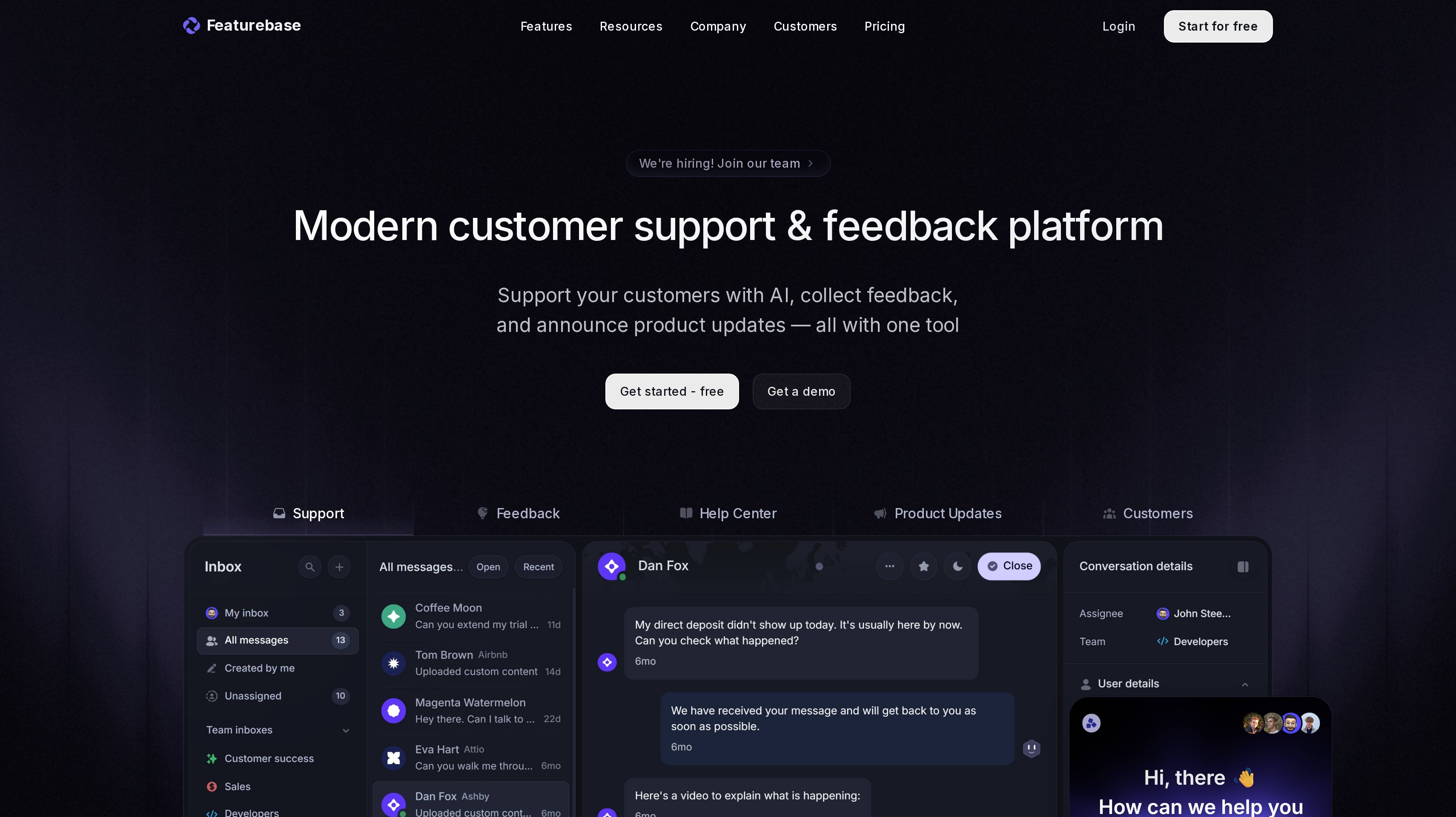
1. Featurebase, best for feedback, roadmap, changelog, and support in one product
Featurebase is a customer support and feedback platform. A feedback portal and in-app widgets collect ideas, users vote on each other's requests, and a public roadmap shows what is planned. When a request ships, Featurebase notifies everyone who asked for it automatically. The same subscription includes a help center, a changelog, outbound surveys, and a support inbox with an AI agent, so a small team can run the whole customer conversation from one tool. That breadth, with a usable free plan, is why it leads this shortlist.
Pricing is per seat, and every plan includes unlimited end users and unlimited posts. Free gives one seat, one feedback board, and one roadmap. Growth is $29 per seat per month billed yearly and adds five boards, embeddable in-app widgets, a custom domain, revenue data sync, NPS and CSAT surveys, and a public changelog page. Professional is $59 per seat per month billed yearly with ten boards, AI deduplication, board privacy, custom post fields, and 20 free Lite seats. Enterprise is $99 per seat per month with unlimited boards, AI tagging, and a prioritization module. The Fibi AI agent costs $0.49 per resolution.
Startups founded less than two years ago with fewer than six employees can apply for 86% off, with Professional features and a year of Fibi included.
The Featurebase integration brings your Featurebase changelog into Affonso, so affiliates always have fresh product news to share with their audience.
Best suited for SaaS teams that want feedback, roadmap, changelog, help center, and support under one login. Per-seat pricing with unlimited end users works well when a small team serves a large user base.
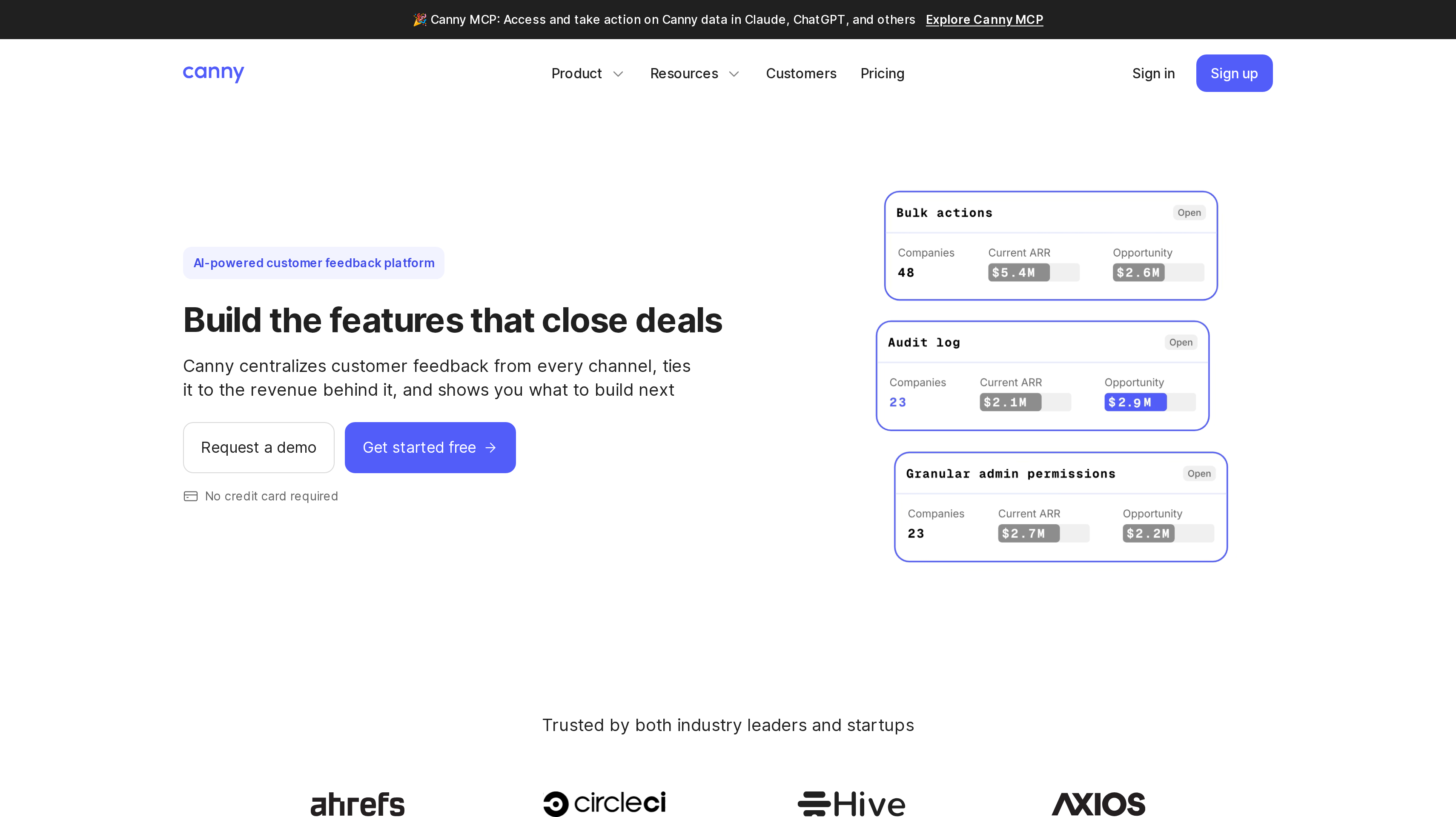
2. Canny, best for tying feature requests to revenue
Canny centralizes customer feedback from every channel and connects it to the revenue behind it. Its Autopilot AI captures feature requests from Intercom, Zendesk, Freshdesk, Gong, Zoom, and other sources, merges duplicates, and summarizes comment threads. Customers can also post and vote on a feedback portal, follow a public roadmap, and read a changelog. Sales and customer success teams use it to show which requests block deals or renewals.
Pricing follows tracked users. A tracked user is anyone associated with feedback, whether they posted, voted, commented, or were captured by Autopilot. Free covers 25 tracked users and five managers, with Autopilot and unlimited feedback and boards included. Pro starts at $79 per month billed yearly for 100 tracked users and ten managers, and adds project management integrations and advanced privacy. Business is custom, starts at 5,000 tracked users, and adds SSO and CRM integrations. Paying yearly saves up to 20%.
Canny says a B2B SaaS company typically sees 1% to 5% of its users become tracked users. You can set a monthly spend limit, so the account stops tracking new users instead of upgrading automatically. Integrations include Jira, ClickUp, Linear, Asana, GitHub, and Azure DevOps for delivery, HubSpot and Salesforce on Business, and an MCP server for Claude, ChatGPT, and Cursor.
Best suited for B2B SaaS teams where sales and customer success want feedback weighted by account value. The free plan is a low-risk way to test whether a public board gets used.
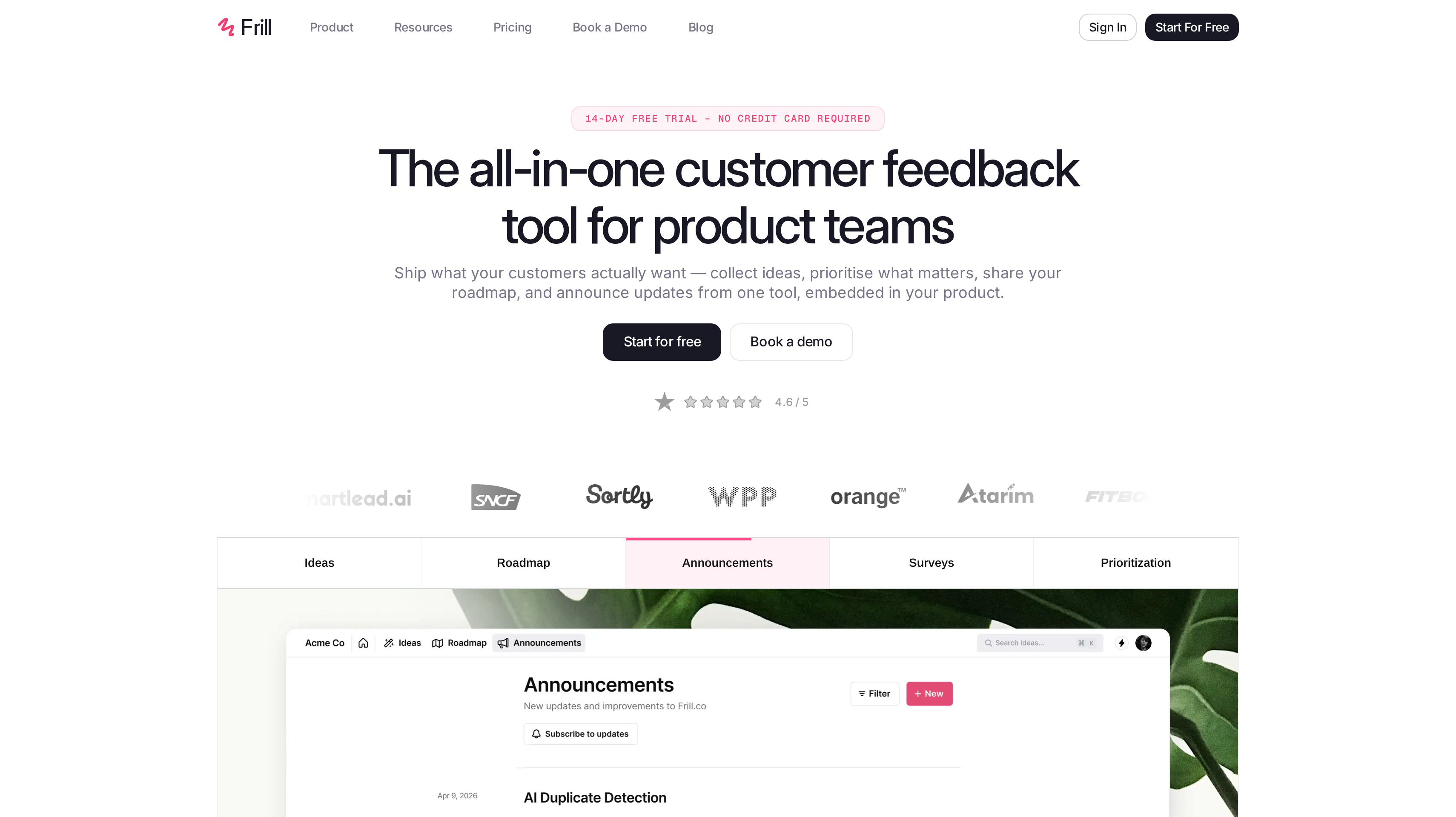
3. Frill, best for an embedded feedback board with flat pricing
Frill bundles ideas, a roadmap, announcements, and surveys into one widget you embed in your product or website. Customers vote, comment, and follow ideas. A drag-and-drop roadmap shows what is coming, and announcements tell users when their request ships. The AI Inbox reads Slack, Zendesk, Jira, Linear, and Trello and pulls out feature requests for you to review and add to the board.
Every paid tier includes unlimited admins, unlimited widgets, and unlimited tracked users. Startup is $25 per month, or $22 per month billed yearly, with 50 active ideas and one survey. Business is $49 per month, or $44 billed yearly, with unlimited ideas and three surveys. Growth is $149 per month, or $136 billed yearly, and includes the privacy, unlimited surveys, and white-labeling add-ons. Enterprise is $349 per month, or $319 billed yearly, with SOC 2 compliance, audit logs, and dedicated hosting. A 14-day trial needs no credit card.
Surveys cover NPS, CSAT, open feedback, quick polls, and idea polls, all embedded in your product. Frill also imports existing boards from Canny and offers a developer API.
Best suited for small product teams that want one embedded widget for ideas, roadmap, and announcements at a predictable monthly price. Flat pricing helps when your user count is growing faster than your team.
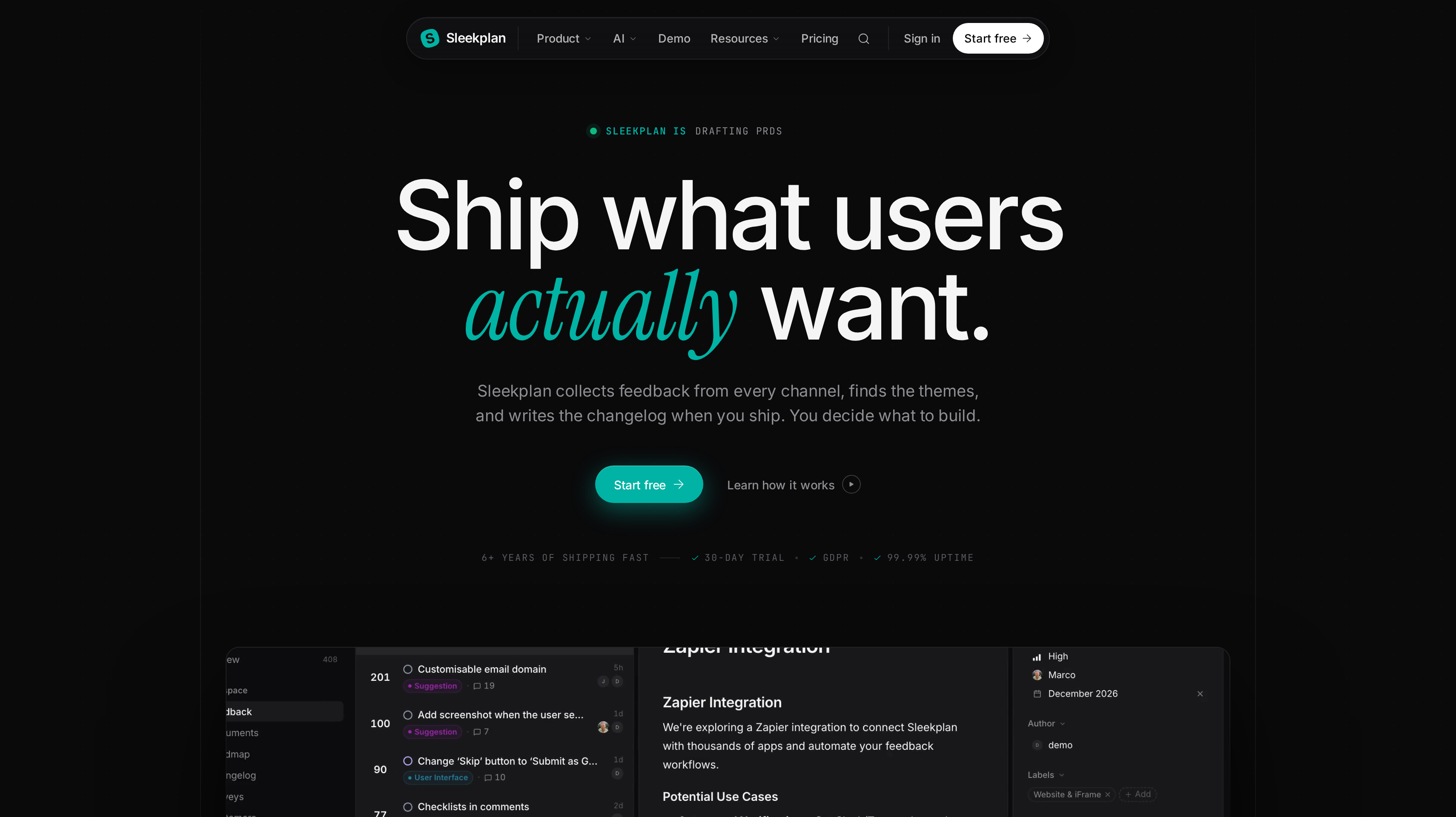
4. Sleekplan, best for a low-cost feedback loop with NPS and surveys
Sleekplan covers feedback boards, a roadmap, a changelog, NPS and CSAT, and in-app surveys in one workspace. AI auto-categorization sorts feedback into themes as it arrives, and Sleekplan can draft the changelog when you ship. A hosted MCP server connects your feedback to Claude and Cursor. Sleekplan lists McKinsey, Mercedes-Benz, Decathlon, and N26 among its customers.
The Indie plan is free forever, with unlimited feedback and subscribers, a feedback board, a changelog, and email and in-app announcements for a single admin. Starter is $13 per month billed yearly and adds three team seats, CSAT and NPS, 1,000 AI credits, SSO, API access, and webhooks. Business is $38 per month billed yearly with ten seats, 5,000 AI credits, surveys, topic analytics, custom domains, and branding removal. Every paid plan starts with a 30-day trial and no card. Paying annually saves two months.
Every plan includes unlimited tracked users. Limits apply instead to announcement views, popup views, and email sends each month, so check those numbers against your active user base.
Best suited for early-stage SaaS and app teams that want feedback, a changelog, and satisfaction surveys without a large software bill. The free Indie plan fits a solo founder running the board alone.
5. Nolt, best for a simple voting board with unlimited users
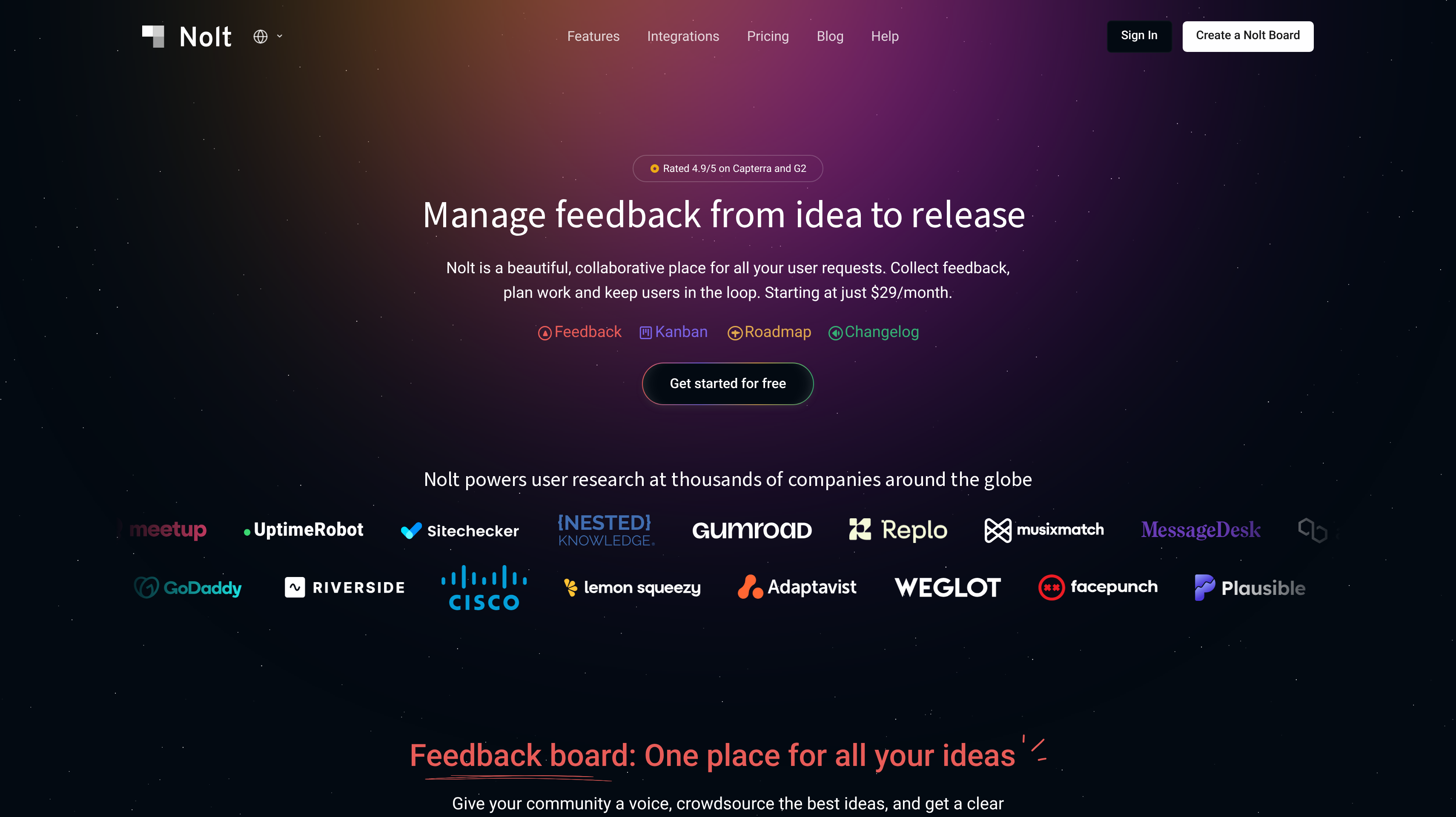
Nolt is a collaborative feedback board for user requests. Users submit and vote on ideas, your team turns them into tasks on a Kanban view, a roadmap shows what is in progress, and a changelog announces finished work. Completed posts can publish to the changelog automatically, and Nolt emails the users who asked. Single sign-on lets people use your app's login, so votes come from real customers.
Pricing is flat, and every plan includes unlimited users, unlimited content, and unlimited admins. Essential is $29 per month billed annually ($348 a year) or $39 month to month, with one board, custom fields and statuses, private boards, a roadmap, JWT-based SSO, and Slack, Discord, GitHub, and Trello integrations. Pro is $69 per month billed annually ($828 a year) or $89 month to month, with five boards, password-protected boards, advanced moderation, and Jira, Linear, Asana, Intercom, Zapier, and Make integrations. Enterprise is custom and adds unlimited boards, SAML, SCIM, and a 99.9% uptime SLA. New boards start with a 10-day Pro trial and no card.
You can choose between global hosting and a Europe-hosted version. Nolt also offers a GraphQL API and an MCP server.
Best suited for teams that want a clean public voting board their users pick up without training. Unlimited users and admins at a flat rate suit consumer apps and large communities.
6. Productboard, best for product teams that plan from customer insights
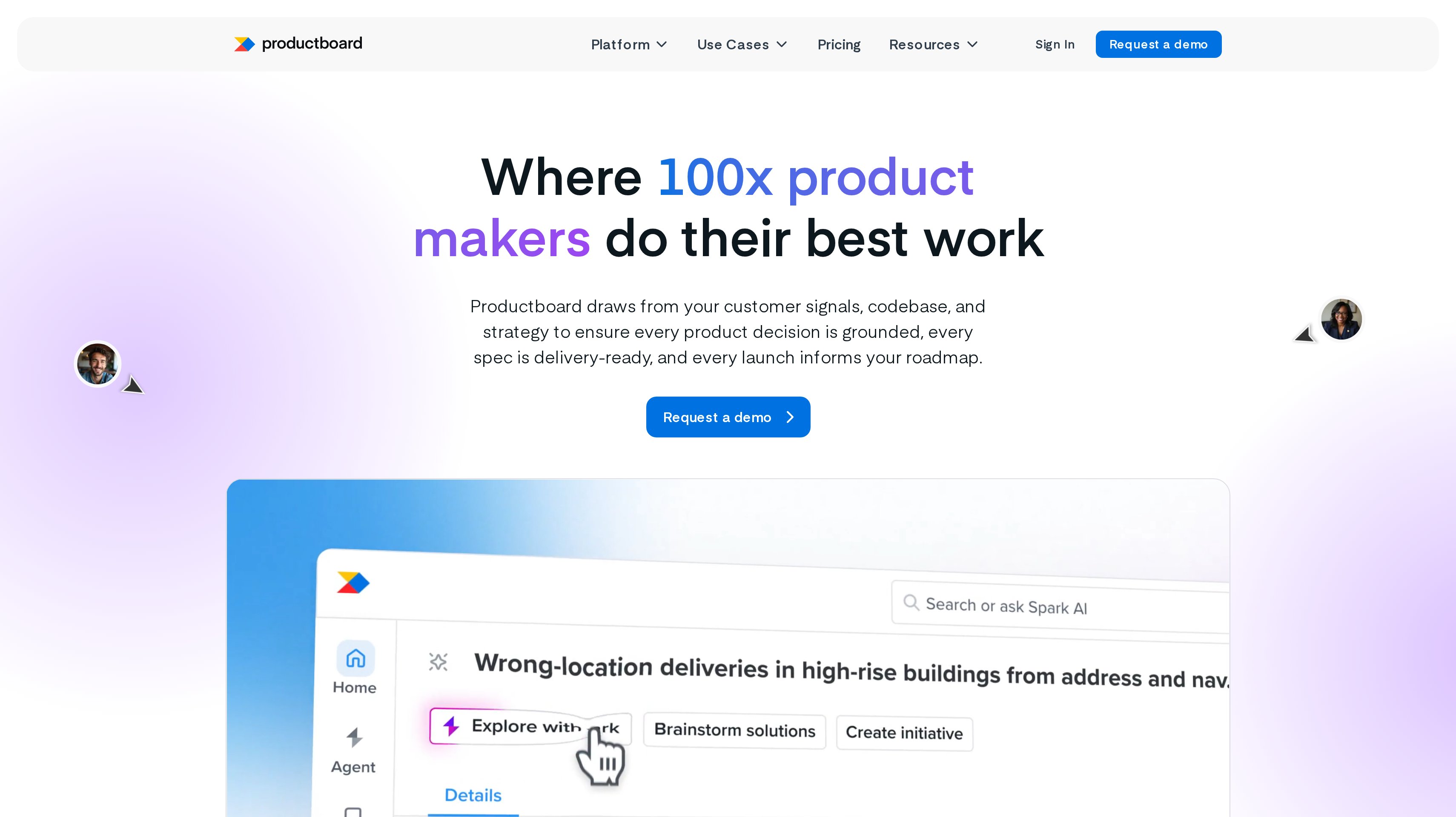
Productboard is a product management platform built around customer feedback. It centralizes feedback notes, links insights to feature ideas, and uses its Spark AI to surface trends, findings, and opportunities with citations back to the original feedback. Roadmaps, custom prioritization formulas, release planning, and dependency tracking sit in the same workspace, so the path from a customer request to a delivery-ready spec stays in one tool.
Productboard sells two plans through its sales team. Business includes full Spark access, unlimited feedback notes and roadmaps, 25 contributors with a minimum of five makers, two Product Portals for customer voting, feedback loop closing, and product usage integrations with Amplitude and Mixpanel. Enterprise adds unlimited contributors, SAML SSO, SCIM provisioning, custom roles, a Salesforce integration, a whitelabeled portal, and live onboarding. Prices are not published, so request a quote for your team size.
Spark connects to Confluence, Google Drive, and Notion as document sources, and Productboard offers an MCP server and MCP connectors on both plans.
Best suited for product organizations with several PMs who need feedback, strategy, and roadmaps in one system. Teams that only need a voting board will use a small part of what it offers.
7. UserVoice, best for enterprise feedback programs with guided onboarding
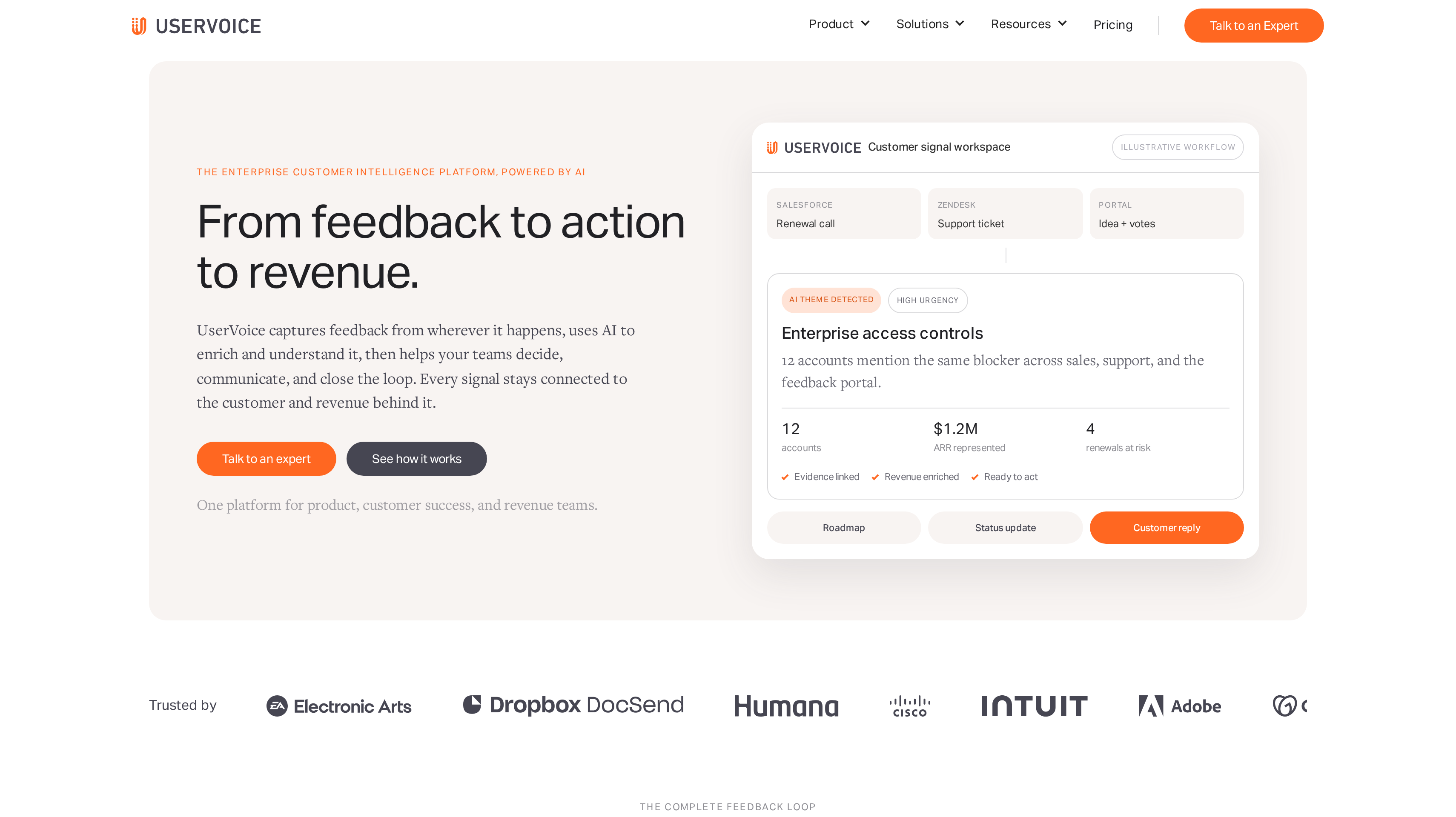
UserVoice is an enterprise customer feedback platform for product, customer success, and revenue teams. Feedback comes in through branded portals with ideas, votes, and status subscriptions, embedded feedback inside your authenticated product, a Chrome extension, Slack capture, and CSV imports. AI detects themes and enriches each request with the accounts and revenue behind it, so a team can see which blockers affect renewals.
UserVoice does not publish prices. Its plans are based on feedback volume, the tools you use, and the integrations you connect, and it never charges by seat, so sales, success, and product can all work in the same account. A 30-day trial is available after a demo. Most teams launch in four to six weeks, including one to two weeks of technical setup, with a dedicated customer success manager.
UserVoice imports feedback from your old platform through CSV or API, and its Technical Success team helps with larger migrations.
Best suited for larger B2B companies that want a structured feedback program with guided rollout and no per-seat limits. Smaller teams usually get running faster with a self-serve board.
8. Survicate, best for in-app, email, and website surveys
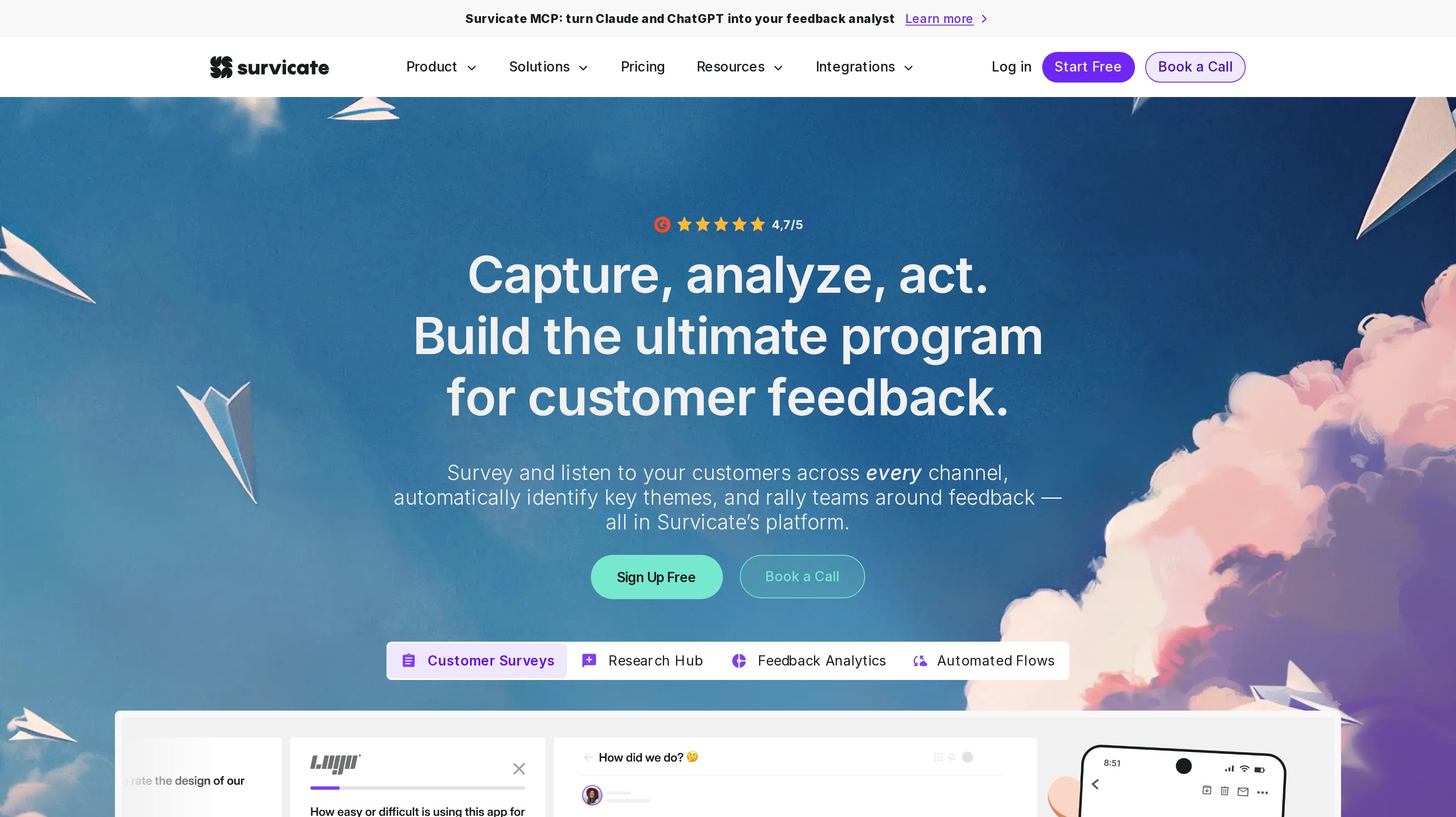
Survicate is survey software for customer feedback. You add surveys to emails, websites, and apps to ask about satisfaction, onboarding, churn reasons, or a specific feature. It also analyzes feedback from support tickets, call recordings, and reviews, sorts answers into topics automatically, and adds CRM and product data to each response. An AI agent and an MCP server let you query the results in Claude or ChatGPT.
Pricing follows response volume. Growth is $114 per month billed annually for 250 survey responses and 1,000 data points a month, with unlimited multichannel surveys, built-in email sending, 25+ integrations, ten user seats, and two teams. The price rises as you add responses. Pro starts at $349 per month with a custom yearly pool of responses, advanced survey logic, and 40+ integrations. Enterprise starts at $569 per month. A 10-day trial includes up to 25 responses with no card.
Survicate does not run a feature-request board. Many SaaS teams pair it with one of the boards above, using surveys for satisfaction scores and the board for requests.
Best suited for product and CX teams that want targeted surveys at specific moments in the customer journey. It answers how customers feel, while a feedback board answers what they want.
Side-by-Side Comparison
The comparison covers collection and capture, prioritization, closing the loop, product and developer fit, and what the entry plan includes. Prices are USD list prices as each vendor publishes them, with billing terms shown.
Tool
Cost and pricing unit
Free plan
Collection and capture
Closing the loop
Product and developer path
Featurebase
Growth $29/seat/mo billed yearly. Professional $59. Enterprise $99
1 seat, 1 board, 1 roadmap, unlimited posts
Portal, in-app widgets, NPS and CSAT surveys, support inbox
Automatic notifications, public changelog, help center
API, MCP, webhooks; Affonso integration
Canny
Pro from $79/mo billed yearly, 100 tracked users
25 tracked users, 5 managers
Portal, widget, Autopilot capture from Intercom, Zendesk, Gong, Zoom
Roadmap, changelog, status updates
Jira, Linear, GitHub, ClickUp; HubSpot and Salesforce on Business; MCP
Frill
Startup $25/mo or $22 billed yearly. Business $49. Growth $149
14-day trial
Embedded ideas widget, AI Inbox, surveys
Roadmap, announcements
Developer API, Canny import
Sleekplan
Starter $13/mo billed yearly. Business $38
Indie plan, unlimited feedback, 1 admin
Boards, NPS, CSAT, in-app surveys, AI categorization
Roadmap, changelog, email and in-app announcements
SSO, REST API, webhooks, JavaScript SDK, MCP
Nolt
Essential $29/mo billed annually or $39 monthly. Pro $69 or $89
10-day Pro trial
Voting board with SSO, custom fields
Roadmap, Kanban, changelog, user emails
Jira, Linear, Asana, GitHub; GraphQL API, MCP
Productboard
Business and Enterprise by quote
None listed
Feedback notes, Product Portals, feedback forms
Roadmaps, release planning, loop closing
Amplitude, Mixpanel, Salesforce on Enterprise; MCP
UserVoice
By feedback volume, tools, and integrations; no seat fees
Status subscriptions, roadmap updates, customer replies
CSV and API import, guided onboarding
Survicate
Growth $114/mo billed annually, 250 responses. Pro from $349
10-day trial, 25 responses
Email, website, and in-app surveys; Research Hub
Automated flows into your tools
25+ integrations on Growth, 40+ on Pro; MCP
Which customer feedback tool fits your use case
Two SaaS companies of the same size can need very different feedback software. Start with who gives the feedback and who has to act on it. These rows map that job to the tools above.
Use case
What changes about the setup
What to look for
Shortlist pick
Small team, many users
A few people answer every request, support ticket, and update.
Per-seat pricing with unlimited end users, help center and changelog included.
Featurebase
B2B sales and renewals
Requests decide deals, and sales needs to show demand by account.
Revenue on each request, CRM integrations, AI capture from calls and tickets.
Canny
One embedded widget
Users should share ideas and read updates without leaving the app.
Embeddable ideas, roadmap, and announcements; flat price.
Frill
Early-stage budget
One founder runs feedback, changelog, and satisfaction checks.
A free plan, low entry price, NPS and CSAT in the same tool.
Sleekplan
Large public community
Thousands of users vote, and moderation matters.
Unlimited users and admins, SSO, moderation tools.
Nolt
Product org with several PMs
Feedback has to roll into strategy, specs, and roadmaps.
Insight linking, prioritization formulas, AI synthesis.
Productboard
Enterprise feedback program
Many teams contribute, and rollout needs a plan.
No seat limits, guided onboarding, migration help.
UserVoice
Satisfaction and churn research
You need answers from specific users at a specific moment.
Targeted in-app and email surveys, topic analysis.
Survicate
Proof: What results look like
Vendors publish their own customer stories. The Lovable team says Featurebase became a cornerstone of its effort to centralize and make sense of product feedback in its early days. In a quote Canny publishes, Freeman Cherng, AI Customer Success Manager at Assembled, explains that without revenue data, a feature affecting $10K of existing revenue could easily beat one with $500K of opportunity value.
Survicate reports that Kard collected 1,000 NPS responses in a day, asked its promoters for reviews, and saw its Trustpilot rating rise from 4.2 to 4.8. UserVoice says users who take part in feedback programs are 20% more likely to become promoters.
Promoters are also your best partners. Jonathan Wilke, founder of supastarter, reports that affiliates refer more than 50% of its customers. See more customer stories, then use the LTV:CAC analyzer to judge what retention and referrals do to acquisition cost.
FAQ
What is the best customer feedback tool for SaaS companies?
Featurebase ranks first in this shortlist because it combines a feedback board, roadmap, changelog, surveys, and support with a free plan and unlimited end users. Canny is the closer fit when feedback should be weighted by revenue for sales and success teams. Frill and Nolt suit teams that want a focused voting board at a flat price.
How much do customer feedback tools cost?
Featurebase Growth is $29 per seat per month billed yearly. Canny Pro starts at $79 per month billed yearly. Frill starts at $25 per month, Sleekplan Starter at $13 per month billed yearly, and Nolt Essential at $29 per month billed annually. Survicate Growth is $114 per month billed annually. Productboard and UserVoice quote prices through sales.
Which customer feedback tools have a free plan?
Featurebase, Canny, and Sleekplan offer free plans. Featurebase Free includes one seat, one board, and one roadmap. Canny Free covers 25 tracked users. Sleekplan Indie includes unlimited feedback and subscribers for a single admin. Frill, Nolt, and Survicate offer free trials instead.
What is the difference between a feedback board and a survey tool?
A feedback board collects requests that customers choose to share, lets others vote, and tracks each request to release. A survey tool asks specific questions at a moment you choose, such as NPS after onboarding or a churn reason at cancellation. Featurebase, Frill, and Sleekplan include both, while Survicate focuses on surveys.
How do customer feedback tools price as you grow?
Check the billing unit first. Featurebase prices by seat. Canny prices by tracked users, the people who post, vote, or comment. Frill and Nolt charge flat monthly rates with unlimited users. Survicate prices by survey responses. UserVoice prices by feedback volume and modules, without seat fees.
Can a customer feedback tool sync with Jira or Linear?
Yes. Canny connects to Jira, Linear, ClickUp, Asana, GitHub, and Azure DevOps. Nolt Pro adds Jira, Linear, monday.com, and Asana. Frill's AI Inbox reads Jira and Linear to find requests. Syncing status back from your delivery tool keeps the public roadmap accurate without manual updates.
How do I turn customers who give feedback into referral partners?
Put the feedback widget inside your product, not only on a separate portal. Use single sign-on so users vote without creating another account. Reply to new posts, and tell everyone who asked when a request ships. Users who see results keep sharing.
Try for free
Pick the feedback tool that matches who talks to your customers today. Put the widget where users already work. Connect it to your support and delivery tools. Announce every shipped request to the people who asked. When those customers start recommending your product, give them a partner program that tracks it. Start your Affonso free trial.
 Affonso
 Silvestro Zinnanti, FounderComparisonOctober 20, 202620 min read