Best auth providers in 2026: the buyer's shortlist.
Compare eight auth providers for SaaS teams. See sign-in methods, organizations and enterprise SSO, AI-agent auth, pricing per active user, and the fit for your team.
Your first login screen is a small part of the auth decision. The harder questions arrive when a customer invites a colleague, an enterprise asks for SSO, or an AI agent needs permission to act.
Those requirements affect your account model, your onboarding, and what you pay as usage grows. A generous user allowance tells you little about the cost of connecting customer directories.
This shortlist covers the best auth providers in 2026. Clerk leads for full-stack SaaS teams that want prebuilt sign-in, user, and organization UI alongside authentication APIs.
Key Takeaways
The short version, before you compare the tools.
Clerk leads when your team wants the user interface included. Prebuilt sign-up, sign-in, and profile components sit alongside organizations, roles, and invitations. Hobby includes 50,000 monthly retained users per app, and Pro starts at $25 per month.
Enterprise access has its own billing unit. WorkOS charges for SSO and Directory Sync by connection, starting at $125 per connection per month. Its AuthKit user management is free for up to one million monthly active users.
A business account needs more than a shared login. Organization membership, invitations, roles, and customer-specific auth policies determine how your users work together. Map those requirements before choosing a free plan by user count alone.
Machine access and agent access deserve separate attention. API keys and M2M tokens cover services. Auth0, Better Auth, and Descope also describe identity capabilities for MCP or agent delegation, where software acts with a user's permission.
Open source changes who runs the system. Better Auth runs inside your TypeScript app with your database. FusionAuth offers a free, unlimited self-hosted Community edition alongside paid plans and several deployment options.
Billing can share the auth platform. Kinde includes subscriptions and billing on Free, with a 0.7% transaction fee on Free and Pro. Clerk Billing also charges 0.7%, on top of Stripe's transaction fees.
What auth providers actually are (and what they are not)
Authentication providers establish who is signing into your app and maintain the session that follows. They handle credentials, social login, passwordless methods, and additional verification such as MFA. Many also provide authorization tools, which help decide what an authenticated person or service can do. Those are related jobs, but your application still needs clear rules for access to its data.
For SaaS, identity extends beyond an individual account. One person might belong to several customer organizations, invite teammates, or administer a company's login policy. Enterprise customers may ask to sign in through their existing identity provider using SSO. Directory provisioning through SCIM helps keep membership aligned with the customer's directory when employees join or leave. Your choice should support the account lifecycle you intend to offer.
Managed services host identity infrastructure for you. A framework such as Better Auth puts auth inside your application and database, while FusionAuth lets you choose where the identity platform runs. Backend platforms bundle auth with a database; this guide covers dedicated auth providers. Prebuilt screens, SDKs, and APIs are different ways to integrate them, so decide how much interface and infrastructure work your team wants to own.
An auth provider does not replace your product's business logic or your responsibility to enforce account boundaries. Subscription billing is included in some products, but a signed-in user still needs the right access for their plan. Connect the buying decision to your acquisition economics with the free LTV:CAC analyzer, then budget for both active users and customer-specific enterprise connections.
How We Ranked These Auth Providers
This shortlist evaluates dedicated authentication products for SaaS teams choosing a managed provider or an open-source implementation. The order favors a useful default for full-stack product teams, then more specific enterprise, deployment, and identity-workflow requirements.
The comparison draws on public pricing, product pages, and vendor documentation. A large free user allowance and a ready-made organization interface solve different problems, so both matter in the ranking.
We compared five criteria:
Sign-in and user experience. Available login methods, MFA, prebuilt screens, profile management, and SDKs. Your team should be able to connect the chosen experience to the app without rebuilding every account screen.
Organizations and enterprise readiness. Multi-tenancy, roles, invitations, SAML or OIDC SSO, SCIM provisioning, and customer admin tools. We distinguish user capacity from the number of enterprise connections included.
Service and agent identity. API keys, machine-to-machine tokens, MCP authentication, and delegated access. The useful question is which actors need identities and whose permission each action uses.
Implementation and operational control. Managed infrastructure, an in-app framework, or a platform you can self-host. Deployment choice affects who maintains the identity service and where account data lives.
Total cost and plan capacity. Base subscriptions, active or retained users, organizations, connection fees, and billing charges. Monthly and annual terms stay attached to the prices they describe.
Published adoption claims and customer results are attributed to whoever reports them. Plan allowances remain separate from feature availability, and managed services are compared alongside software your team operates. We plan to review this guide quarterly and after material pricing changes.
The Best Auth Providers in 2026
Start with the account experience you need to ship. The eight tools below cover prebuilt SaaS interfaces, enterprise identity connections, usage-based services, and auth you operate yourself. Their position in this list reflects a particular buying job, so use the fit descriptions to build a shortlist around your product's users, customer organizations, and deployment requirements.
1. Clerk, best for full-stack SaaS teams that want prebuilt account UI
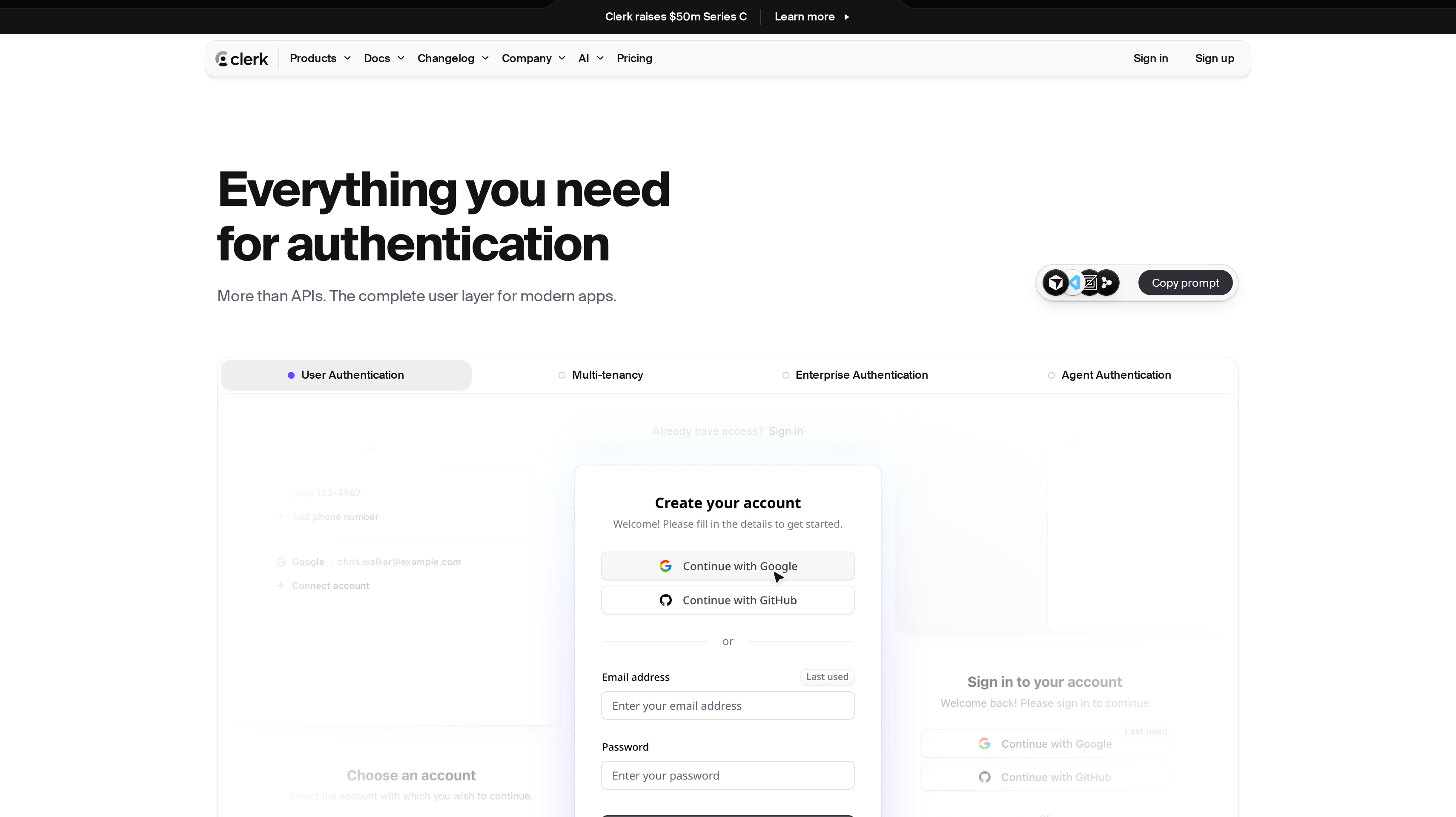
Clerk combines authentication APIs with prebuilt sign-up, sign-in, and user-profile interfaces. B2B authentication adds organizations, roles, and invitations, so your team can build account onboarding around customer workspaces. That combination of user management and ready-made screens puts it first here. You get a starting point for the parts of SaaS identity your customers actually see.
Hobby is free without a credit card and includes 50,000 monthly retained users, or MRU, per app, up to three dashboard seats, a custom domain, and a fixed seven-day session lifetime. Every plan supports unlimited applications. The free B2B add-on includes 100 monthly retained organizations per app, with up to 20 members in each organization.
Pro costs $25 per month, or $20 per month billed annually. It includes 50,000 MRU per app, then $0.02 per additional MRU, MFA, branding removal, one SSO connection, and one directory sync connection. Additional SSO connections cost $75 per month each. Enhanced B2B costs $100 per month, or $85 billed annually. Those allowances make organization usage a separate part of your estimate.
Machine authentication covers API keys and M2M tokens, while OAuth consent supports AI tools. Clerk Billing adds subscriptions with a 0.7% fee on top of Stripe's transaction fees. For a team building both user-facing and service access, that puts several identity tasks in the same product.
Best suited for full-stack teams that want account screens and organization management ready to integrate into a SaaS product. You can spend implementation time on your app's access rules and onboarding rather than designing every sign-in and profile screen.
2. Auth0, best for mature customer identity and broad enterprise features
Auth0, by Okta, is a customer identity platform covering login, passwordless authentication, social connections, MFA, organizations, and attack protection. AI identity adds agent identities, authentication for MCP, asynchronous authorization, and Fine-Grained Authorization for RAG. You can evaluate human and agent access within the same identity brief.
Its B2C Free plan includes up to 25,000 monthly active users, unlimited social connections, passwordless login, five organizations, and basic attack protection. It also includes one enterprise connection, self-service SSO, SCIM, and community support. One custom domain is included with credit-card verification. Keep that B2C plan context attached to the allowances when comparing your requirements.
B2C Essentials starts at $35 per month for up to 500 MAU. It adds Pro MFA, role-based access control per organization, ten organizations, separate production and development environments, and log streaming to Datadog, Splunk, AWS, or Azure. B2C Professional starts at $240 per month for up to 500 MAU and adds an existing user database connection, enterprise MFA, custom token exchange, and enhanced attack protection.
Enterprise pricing is through sales, with a 99.99% uptime SLA and a private deployment add-on. Build your comparison around the tier that contains your required identity controls.
Best suited for teams managing established customer identity requirements across organizations, enterprise access, and AI agents. Your evaluation can cover login policies, application permissions, and delegated access together.
3. WorkOS, best for B2B SaaS that needs enterprise SSO and directory sync
WorkOS provides building blocks for enterprise features. AuthKit handles user management with social authentication, MFA, role-based access control, organizations, and passwordless codes. SSO connects to SAML or OIDC identity providers, and Directory Sync handles SCIM provisioning. The Admin Portal gives your customers' IT administrators a place to configure their connection.
AuthKit is free for up to one million monthly active users. Each additional million costs $2,500 per month. That user allowance sits separately from enterprise connection pricing, so a product with few users and several business customers has a different cost model from a large self-serve app. Count the connections your customers will need alongside your user forecast.
SSO and Directory Sync each start at $125 per connection per month for connections one through 15. The published bands fall to $100 for 16 through 30, $80 for 31 through 50, and $65 for 51 through 100. A custom domain costs $99 per month. You can start without a credit card until production, and an annual credits plan includes a 99.99% uptime SLA.
Audit Logs and Radar extend the enterprise toolkit. Audit log streaming costs $125 per month per SIEM connection, while event retention costs $99 per month per million events. Radar includes the first 1,000 bot and fraud checks free, then costs $100 per month per 50,000 checks. These are distinct line items in an enterprise rollout.
Best suited for B2B product teams turning enterprise SSO and employee provisioning into customer-facing capabilities. Your customers' IT teams can configure access through the Admin Portal while your developers work with the underlying identity building blocks.
4. Stytch, best for usage-based auth without feature gating
Stytch combines authentication, authorization, and security for B2B SaaS and consumer applications. Passkeys, SAML SSO, SCIM, and role-based access control sit alongside built-in multi-tenancy and organization-level auth policies. Prebuilt login and admin portal UI give your team an interface to start from. Stytch describes its model as having no feature gating.
Pay as you go starts at $0 per month, with 10,000 monthly active users and AI agents always free. The allowance also includes unlimited organizations, five SSO or SCIM connections, 1,000 M2M tokens, and 10,000 device fingerprints. Those are separate usage measures, so list the users, customer connections, and machine activity your app expects to generate.
Beyond the included usage, an extra SSO or SCIM connection costs $125. Full email customization and removal of Stytch branding carry a $99 fixed fee. Additional device fingerprints cost $0.005 each. The usage model has no hard caps or pricing cliffs, with payment for consumption beyond the free allowances. Feature access and included consumption are different parts of that arrangement.
Device fingerprinting supports fraud and risk prevention, and SMS and email provider failover supports the messaging side of login. Enterprise has custom pricing, a 99.99% uptime SLA, and HIPAA with a BAA.
Best suited for teams building B2B or consumer apps that want broad feature access and a usage-based commercial model. You can evaluate organization policies, passwordless methods, and fraud controls against the same application's needs.
5. Better Auth, best for TypeScript teams that want open-source auth in their app
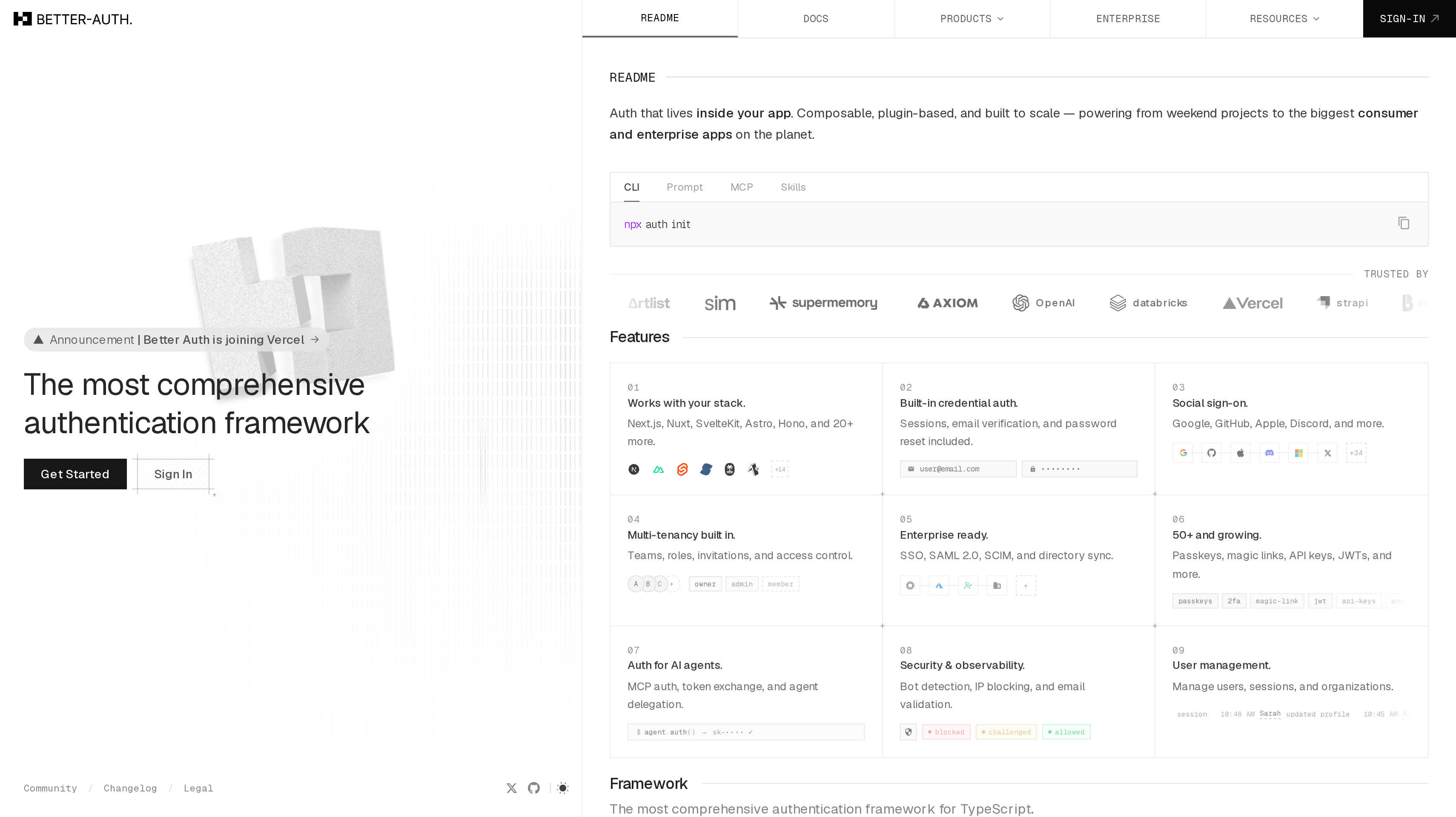
Better Auth is a framework-agnostic authentication and authorization framework for TypeScript. It runs inside your application with your own database and includes automatic database management and migrations. There is no per-user pricing for the library you install. Your team operates the application and database that carry the identity system, which makes this a different implementation choice from buying hosted user management.
Built-in capabilities include email and password login, sessions, email verification, password reset, rate limiting, and social sign-on. Supported social providers include Google, GitHub, Apple, and Discord. That gives you the core account lifecycle before you choose additional plugins. Start with the sign-in methods your users need, then add the account controls your product requires.
Plugins cover two-factor authentication, passkeys, magic links, API keys, and JWTs. Organizations, teams, roles, and invitations support business accounts. SSO, SAML 2.0, SCIM, and directory sync extend the framework into enterprise access. Your plugin selection determines which of those capabilities run alongside your application code.
MCP authentication and agent delegation are available through plugins, along with bot detection and IP blocking. You can also run your own identity provider. Framework support includes Next.js, Nuxt, SvelteKit, Astro, Hono, and more than 20 others, so the decision can follow an existing TypeScript stack.
Best suited for TypeScript developers who want authentication to live in their own app and database. Your team can assemble login, organization, enterprise, and agent capabilities through the framework and its plugins.
6. Kinde, best for startups combining auth and subscription billing
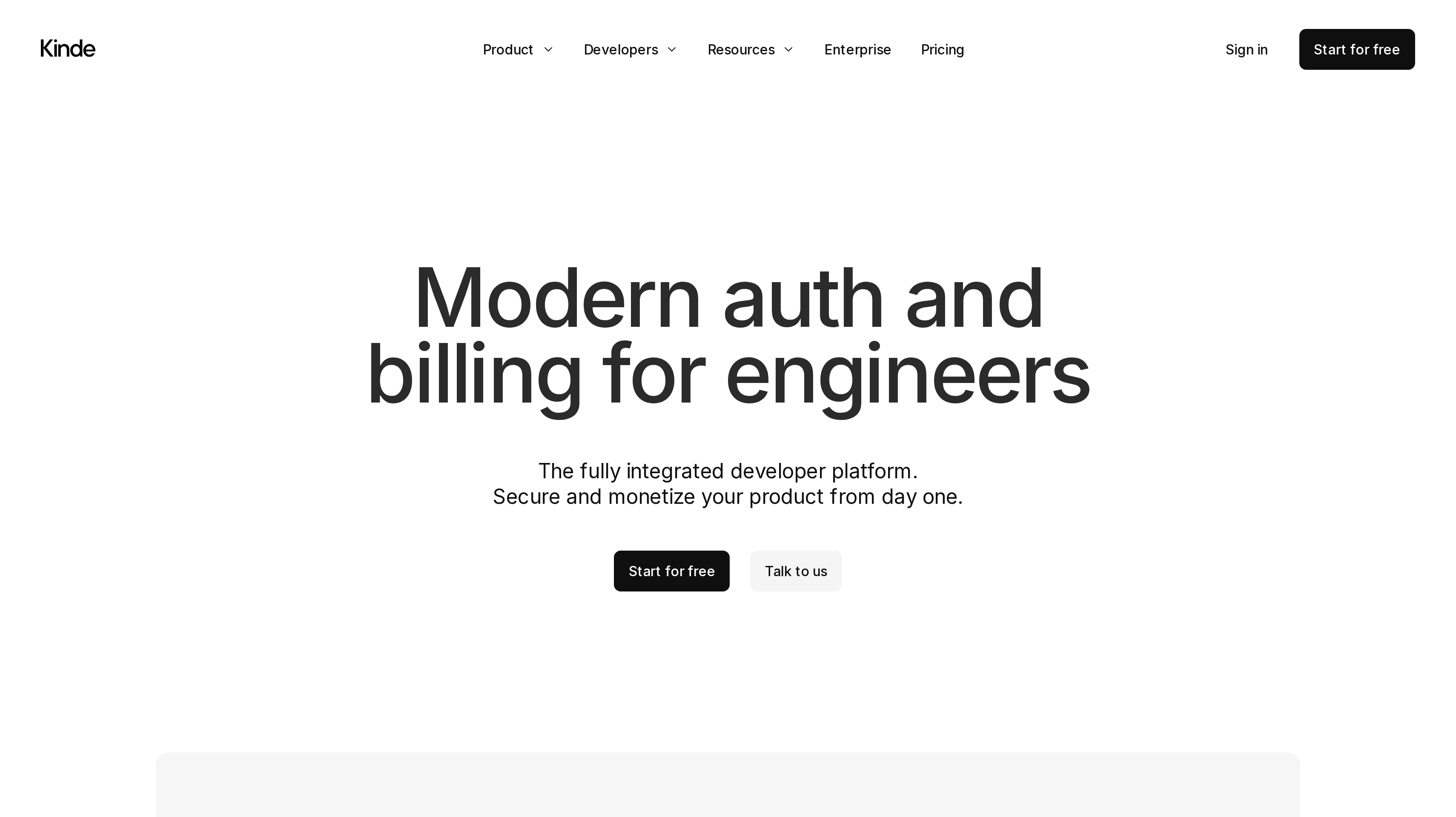
Kinde puts authentication, subscriptions, and billing in one developer platform. For a startup deciding how accounts and paid plans should fit together, that means evaluating both in the same buying decision. SDKs cover Next.js, React, Node, Python, PHP, Java, .NET, Flutter, Android, SvelteKit, Remix, and more. Your language and application framework can guide the integration path.
Free includes 10,500 monthly active users without a credit card. It covers email, SMS, and social login, MFA, B2B organizations, a custom domain, workflows, attack protection, M2M apps, and two environments. Subscriptions and billing are included. Those capabilities give you an account model and a route to charging customers within the same platform.
Pro costs $25 per month, with 10,500 MAU free and $0.0175 per additional MAU. It adds API keys, Kinde branding removal, and a SOC 2 report, with uncapped MAU and organizations. Plus costs $75 per month and adds free enterprise SSO and six environments. Scale is $250 per month.
When you bill customers through Kinde, the transaction fee is 0.7% on Free and Pro and 0.6% on Plus. Monthly active users who are billed through Kinde are free. That makes the split between billed users and other active users part of your cost estimate, alongside the transaction fee.
Best suited for startups that want signup, customer organizations, and paid subscriptions in one developer platform. Your team can compare identity usage and subscription billing together while planning the path from a new account to a paying customer.
7. FusionAuth, best for teams that need control over identity deployment
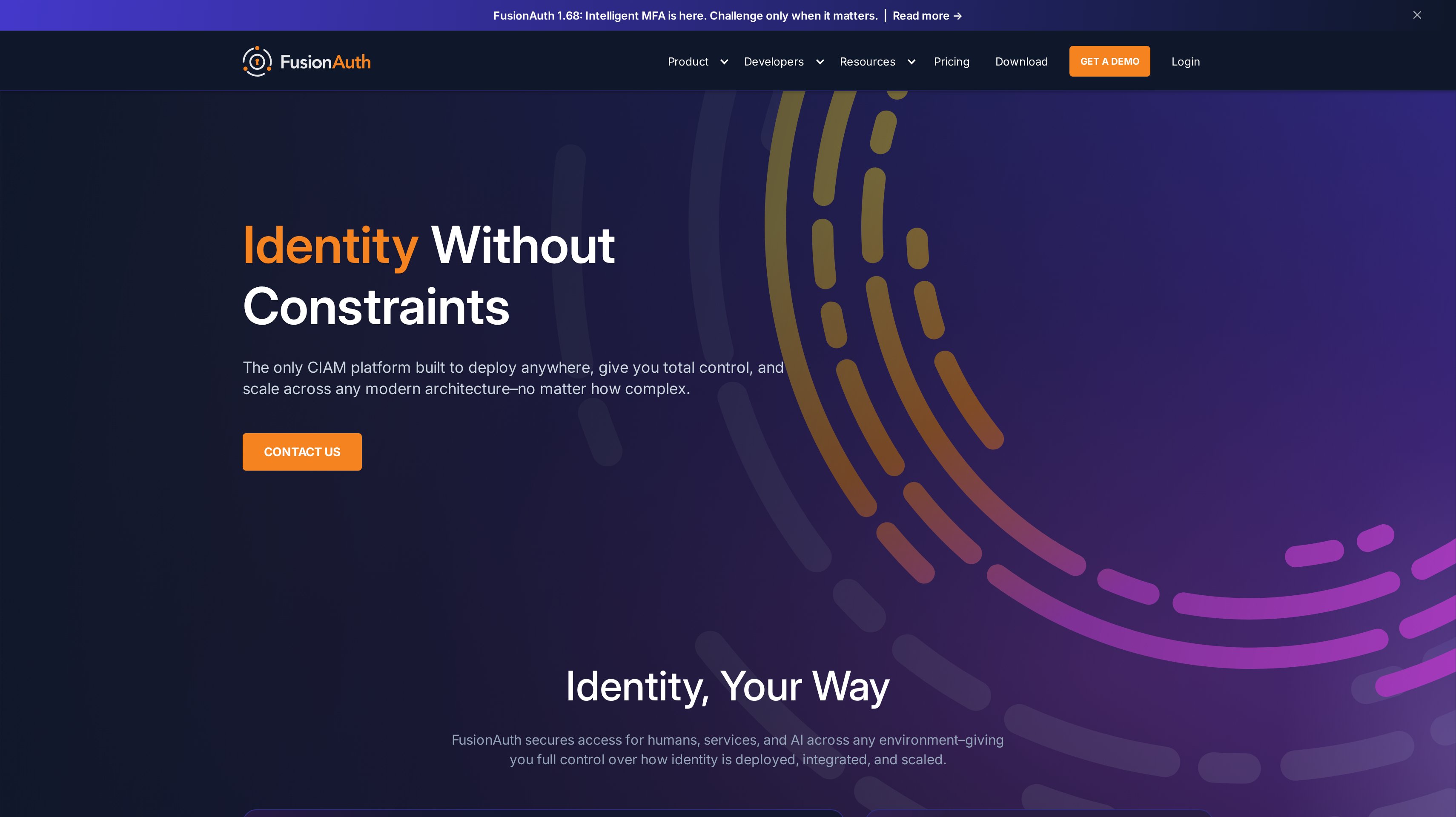
FusionAuth is a customer identity and access management platform built to deploy in different environments. Options include self-hosted, dedicated, on-premises, hybrid, and air-gapped setups. It covers authentication for humans, services, and AI with fine-grained authorization, and every capability is available through an API. Deployment control is the central buying reason here.
Community is free and unlimited when self-hosted, with core authentication features and community support. Include the work of operating that deployment in the decision, alongside the user-facing authentication requirements. Software capacity and responsibility for running the service are separate questions.
Starter begins at $162 per month billed annually. It includes basic hosting and premium capabilities such as advanced MFA, application theming, breached password detection, and machine-to-machine authentication. Essentials begins at $240 per month billed annually and adds custom OAuth scopes, email support, and business hosting. Those plans provide different combinations of identity features, support, and hosting.
Enterprise pricing is through sales, with advanced threat detection, SSO Tenant Manager, 24/7 support, and high-availability hosting. Write down where identity must run and which controls your customers require before comparing the plans. That gives the deployment conversation a concrete scope, whether your team wants self-hosting or a hosted arrangement.
Best suited for teams choosing identity software around where it must run and who will operate it. You can align a self-hosted, on-premises, hybrid, or dedicated deployment with your infrastructure requirements and support needs.
8. Descope, best for visual identity journeys and agentic or MCP access
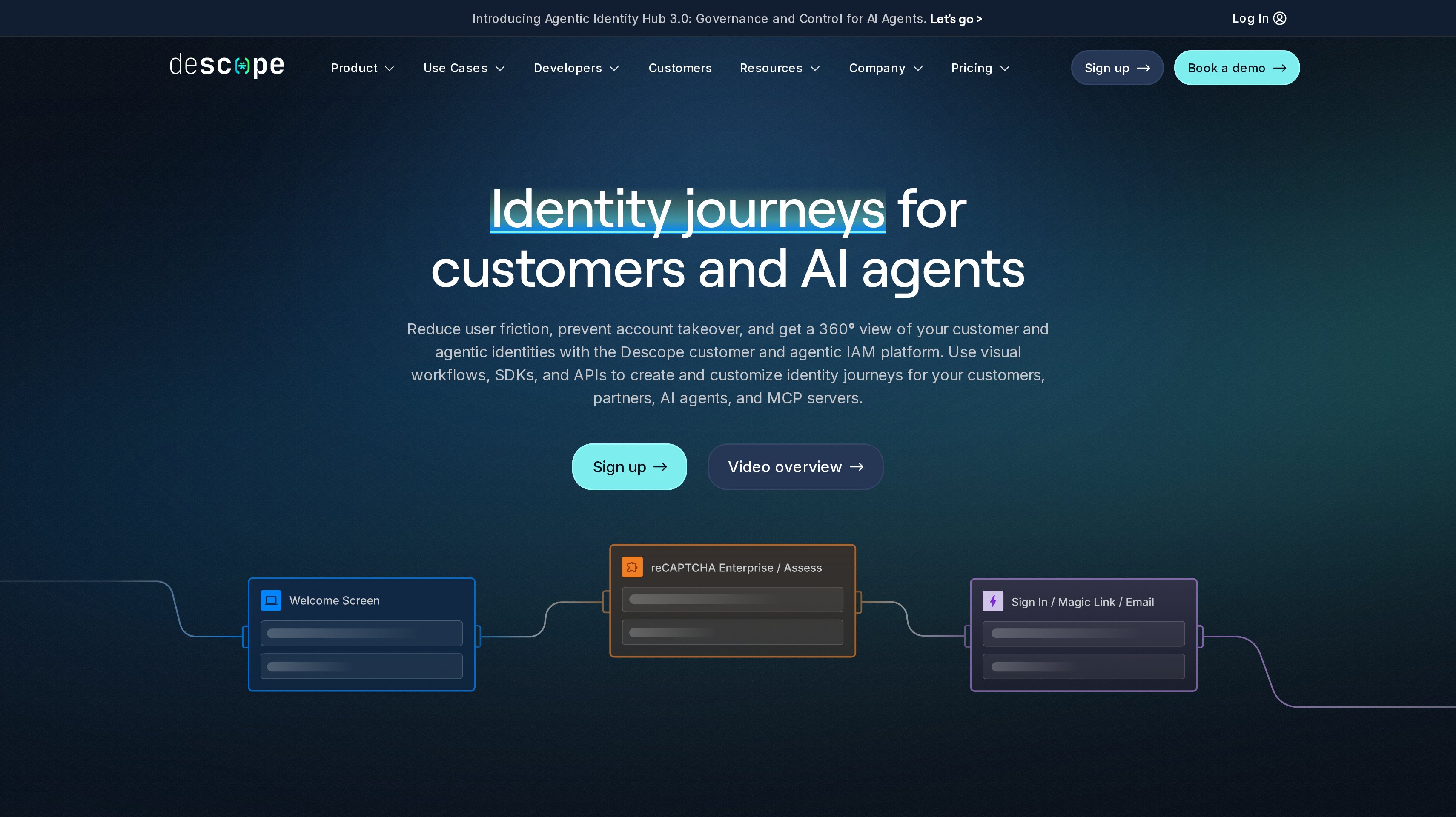
Descope combines customer and agentic identity and access management. Visual no-code workflows, SDKs, and APIs let your team build identity journeys for customers, partners, AI agents, and MCP servers. Agentic Identity Hub 3.0 adds AI agent governance. The visual workflow approach is a specific reason to shortlist it when your sign-in journey needs more than a standard screen.
Free Forever includes 7,500 monthly active users, ten monthly active tenants, three SSO connections, all authentication methods, role-based access control, and MFA or step-up authentication. There is no Descope watermark. The free plan has no overages, and exceeding its limits requires an upgrade. Count tenants and SSO connections alongside people when planning the rollout.
Pro starts at $249 per month billed annually, with 10,000 MAU, 35 tenants, and five SSO connections. It adds a custom domain, self-service SSO setup, SOC 2 reports, and a 99.99% SLA. Additional MAU cost $0.05 each. Growth starts at $799 per month billed annually, with 25,000 MAU, ten SSO connections, SCIM, bot protection, fine-grained authorization, and multi-region data residency.
The Hello World Startup Plan gives eligible early-stage startups the Pro tier free for a year. For an initial evaluation, map a customer login journey and an agent access journey separately. Your team can then decide which workflow steps, tenant allowances, and governance capabilities belong in the implementation.
Best suited for teams that want to design identity journeys visually across customers, partners, and agents. Your developers can combine no-code workflows with SDKs and APIs while planning access to applications and MCP servers.
Side-by-Side Comparison
Compare the sign-in experience, organization model, enterprise connections, and service or agent access together. Prices below are USD list prices with billing terms shown; MAU means monthly active users, while Clerk uses monthly retained users, or MRU. Free usage, paid-plan capacity, and connection charges remain separate in the table.
Tool
Cost and user capacity
Sign-in and account UI
Organizations and enterprise access
Service and agent identity
Implementation
Clerk
Hobby: 50,000 MRU/app free. Pro $25/mo or $20/mo billed annually; then $0.02/MRU
Prebuilt sign-up, sign-in, profile UI; MFA on Pro
Free B2B add-on: 100 retained organizations/app, 20 members each. Pro: 1 SSO and 1 directory sync connection
API keys, M2M tokens, OAuth consent for AI tools
Managed APIs and prebuilt UI; unlimited applications
Auth0
B2C Free: 25,000 MAU. B2C Essentials from $35/mo for 500 MAU; Professional from $240/mo for 500 MAU
Passwordless, social login, MFA, attack protection
Free: 7,500 MAU. Pro from $249/mo billed annually, 10,000 MAU; $0.05/extra MAU
Visual workflows, all auth methods, MFA/step-up
Free: 10 active tenants, 3 SSO connections. Growth adds SCIM
Agentic Identity Hub 3.0, AI agent and MCP identity journeys
No-code workflows, SDKs, and APIs
Which auth provider fits your use case
Two products with the same user count can have very different identity requirements. A self-serve app may prioritize account screens, while an enterprise sale depends on directory provisioning and an IT admin's setup experience.
Choose the row closest to the work your team needs to ship next. Then compare the plan that includes that capability, using your expected organizations and connections as well as active users. For a B2B evaluation, walk through an invitation, a role change, and a departing employee's access. For an agent workflow, write down which action needs a service credential and which needs a person's consent. These scenarios turn a feature list into an implementation brief your developers and customer-facing teams can use together.
Use case
What changes about the setup
What to look for
Ship a full SaaS account experience
Customers need sign-in, profiles, invitations, and organization membership inside your product.
Clerk's prebuilt user and organization UI, with MRU and retained-organization allowances modeled separately.
Manage broad customer identity requirements
Login policies, organization roles, security controls, and agent access belong in one evaluation.
Auth0's customer identity platform, enterprise controls, and AI identity capabilities on the relevant plan.
Sell to enterprise IT teams
Each customer may need an identity-provider connection and directory provisioning.
WorkOS SSO, Directory Sync, and Admin Portal; price each connection alongside AuthKit usage.
Use a broad feature set with usage billing
Your app needs organizations, risk checks, and several login methods while consumption grows.
Stytch's no-feature-gating model, included connections, M2M tokens, and device fingerprint allowance.
Operate auth within your infrastructure
Identity needs to run in your app and database or in a deployment you control.
Better Auth for a TypeScript framework; FusionAuth for self-hosted, on-premises, hybrid, or air-gapped identity.
Combine billing or customize identity journeys
Your priority is accounts with subscriptions, or visually designed access for customers and agents.
Kinde for auth and billing together; Descope for visual workflows, agent governance, and MCP identity.
Proof: What results look like
Kinde says more than 70,000 developers trust its platform. Descope says thousands of organizations use its product. Those vendor-published claims describe adoption. Your own evaluation still needs to show that a user can join the right organization and that an administrator can configure the required access.
Once that account experience is in place, partner acquisition becomes a separate growth task. In a published Affonso testimonial, supastarter founder Jonathan Wilke says affiliates bring in more than half of its customers. SocialRails founder Matt describes getting Affonso running in 30 minutes and receiving eight leads. These customer reports concern the partner channel once the product stack is in place.
Read the customer testimonials for that part of the stack, then use the affiliate commission calculator to plan a reward your subscription margins can support. Evaluate signup and partner acquisition against their own outcomes.
FAQ
What are the best auth providers for a SaaS product?
Clerk ranks first here for teams that want prebuilt sign-in, profile, and organization UI. WorkOS fits enterprise SSO and directory provisioning, while Auth0 covers a broad customer identity brief. Choose the shortlist around the account experience and access requirements you need to deliver.
How do authentication providers handle organizations and multi-tenancy?
Organizations group users into business accounts with membership and roles. Clerk includes organization UI and invitations, Stytch has built-in multi-tenancy and organization-level policies, and Better Auth offers organization and team plugins. Your app still needs to enforce which customer data each membership permits someone to access.
How should I compare pricing per active user?
Keep MAU and Clerk's MRU as distinct billing units, then add the subscription and enterprise connections your setup requires. Kinde also makes billed users' MAU free when you use its billing. Forecast customer organizations, SSO or SCIM connections, and machine usage alongside users to get a useful estimate.
Which of the best auth providers support AI agents and MCP?
Auth0 describes agent identities, MCP authentication, and asynchronous authorization. Better Auth has MCP auth and agent delegation plugins, while Descope covers agent and MCP identity journeys. Clerk provides OAuth consent for AI tools; identify whether your requirement is service credentials, user delegation, or agent governance before comparing them.
What is the difference between SSO and SCIM?
SSO lets a customer sign in through an existing identity provider. SCIM handles provisioning, such as keeping account membership aligned with a company directory. A customer can require both, so treat the login connection and directory connection as separate requirements when comparing included allowances and connection-based pricing.
What are the main Auth0 alternatives for a TypeScript SaaS team?
Clerk is a fit when you want managed auth with prebuilt account interfaces. Better Auth puts the framework inside your TypeScript app and database. WorkOS is another shortlist option when enterprise SSO, directory provisioning, and the customer admin setup drive the decision.
How do I choose between managed auth and self-hosted auth?
Start with who will operate identity and where it must run. Better Auth runs with your app and database, and FusionAuth supports self-hosted, dedicated, on-premises, hybrid, and air-gapped deployments. Compare those responsibilities with a managed provider's account experience, required features, and usage model.
How do I attribute partner-referred signups after adding authentication?
Use Affonso's API integration or SDK integration to connect referred signups to partners, and the Stripe integration to connect subscription payments. These are application and billing integration paths. None of the eight auth providers in this shortlist has a native Affonso integration.
Try for free
Choose the identity provider around the account experience your next customers need. Walk through signup, an organization invitation, and the permissions that follow. Include enterprise connections in the estimate if your buyers require them. When customers and creators recommend your product, give them affiliate and partner programs with clear rewards. Track the referred signup through to subscription revenue and commission. Start your Affonso free trial.
 Affonso
 Silvestro Zinnanti, FounderComparisonOctober 23, 202623 min read