Best A/B testing tools in 2026: the buyer's shortlist.
Compare seven A/B testing tools for SaaS, app, and plugin teams. See pricing, free plans, testing types, stats engines, and the fit for your team.
Your pricing page gets traffic, but your team disagrees about what to change. One person wants a shorter signup form. Another wants a different offer. Shipping either tells you what happened afterward, without showing what would have happened otherwise.
A controlled experiment gives you that comparison. You divide eligible users between versions and measure a result you chose before launch.
This shortlist covers the best A/B testing tools for SaaS, app, and plugin teams in 2026. VWO takes the top spot for marketing and growth teams running website experiments.
Key Takeaways
Here is where to start before you compare plans.
VWO leads for website experimentation. Its visual and code editors cover pricing-page and signup tests, with advanced targeting and guardrail metrics on Pro. Optimizely is the enterprise pick when experimentation spans a larger program.
Choose where the experiment runs first. Client-side tests change the website experience in the browser. Server-side tests assign a variation in your application, which matters when you change product behavior, backend logic, or an authenticated onboarding flow.
Free plans can support real product experiments. Statsig Developer includes 2 million events per month and unlimited flag checks. GrowthBook Starter includes unlimited experiments and traffic for up to three users, while LaunchDarkly Developer includes experiments within its client-side user and service-connection allowances.
Transparent prices come with different units. Convert Growth is $299 per month billed annually for 100,000 tested users per month. GrowthBook Pro is $40 per seat per month, while Statsig Pro starts at $150 per month with 5 million events included.
The stats engine affects how you make decisions. Bayesian, frequentist, and sequential methods answer related questions in different ways. GrowthBook also includes CUPED and sample ratio mismatch detection, so a data team can work on precision and experiment health alongside the result.
AI can build a variant, but your team still owns the hypothesis. Kameleoon turns prompts into front- and back-end variants. Decide what a meaningful improvement looks like, which users qualify, and which metrics must stay healthy before sending traffic.
What A/B testing tools actually are (and what they are not)
A/B testing software assigns users to a control or a variation, delivers the intended experience, and compares outcomes. An A/B/n test adds more variations. Split URL testing sends visitors to separate page addresses, while multivariate testing compares combinations of changed elements. The useful output is evidence about whether a change caused an improvement, with uncertainty around that estimate.
For a SaaS company, the test might start on a marketing page and end at a paid subscription. A clearer pricing table can increase signups while changing the mix of customers who buy. Inside your app, a different onboarding sequence might affect activation or retention. Choose the outcome that matches the decision, and keep assignment consistent for the person or account you are testing.
Feature flags control who receives a feature; an experiment adds a comparison and a measurement plan. A progressive rollout can expose a release gradually without proving that it improves a business metric. Guardrails help you watch for harm elsewhere, such as a signup improvement accompanied by more errors. Heatmap and product analytics tools are separate categories that describe behavior and help generate hypotheses.
The platform cannot choose your business goal or create traffic you do not have. Before testing an offer, estimate what a new customer is worth and what you can spend to acquire one. The free LTV:CAC analyzer gives you a starting point for that calculation. Then define the experiment's primary metric, eligibility, and stopping rule so the team agrees on the decision before seeing results.
How We Ranked These A/B Testing Tools
This shortlist focuses on controlled experiments across SaaS marketing sites and products. The ranking starts with the website workflow most growth teams need, then covers enterprise programs, product experiments, warehouse-based analysis, and engineering-led releases.
Public product descriptions, plan details, and vendor documentation provide the basis for the comparison. A visual editor, a statistical method, and a rollout control each solve a different part of the job.
We compared five criteria:
Experiment coverage. A/B/n, split URL, multivariate, and server-side testing, including the plan that unlocks each type. Your test should run where the proposed change actually happens.
Statistical decisions. The available inference methods, sequential analysis, variance reduction, and checks for sample ratio mismatch. A readable result matters as much as the ability to build a variant.
Safe delivery. Targeting, guardrail metrics, feature flags, rollouts, and approvals. These controls determine how your team limits exposure and handles a change that hurts another metric.
Team and data fit. Visual and code editors, SDKs, warehouse-native analysis, and hosting options. The person who builds a test and the person who interprets it both need a workable setup.
Entry cost and capacity. Paid starting plans, free allowances, trials, and the usage unit. Seats, events, tested users, and service connections create different costs for the same experiment program.
Vendor-reported customer results appear separately from the ranking. A large deployment demonstrates operating scale; it does not establish the lift your own test will produce. We intend to revisit this shortlist quarterly and when a material pricing or product change affects a buying decision.
The Best A/B Testing Tools in 2026
Your first experiment might change a headline, a signup journey, or a feature behind a flag. Those jobs need different editors, delivery controls, and data access. These seven tools cover the main buying paths, with website experimentation first and more specialized product workflows further down the list.
1. VWO (Wingify), best all-round website experimentation platform
VWO combines a visual editor and a code editor with website testing and rollout campaigns. A marketer can build a pricing-page variation, while a developer can make a more involved change in the same workflow. That combination puts it first for growth teams whose experiments live mainly on the marketing site. VWO now presents its offering as the Wingify Platform.
Web Experimentation & Rollout covers A/B/n, split URL, and multivariate tests, with capabilities separated by plan. Growth includes the visual and code editors, unlimited experiments, variations, and metrics, plus multi-arm bandit and rollout campaigns. A QA assistant and single-page application support help you prepare tests for modern websites.
Pro adds advanced targeting, guardrail metrics, sample ratio mismatch detection, multivariate testing, and cross-domain testing. These are useful distinctions when a signup journey crosses domains or your team needs to protect another metric while testing conversion. Enterprise adds self hosting, approval workflows, mutually exclusive groups, SSO, API access, and 24/7 support.
Pricing is quote-based, with a trial and demo available. Data centers are in the US, EU, and India. Wingz AI Core comes with Wingify products and includes MCP and AI Analyze; the paid Advanced upgrade adds AI Workflow, AI Autopilot, and Synthetic AB Test. Those assistants sit alongside the experiment setup and measurement decisions your team makes.
Best suited for marketing and growth teams running a regular website testing program across pricing pages and signup journeys. The shared visual and code workflow lets marketers and developers contribute to the same experiment backlog.
2. Optimizely, best for enterprise experimentation programs
Optimizely brings web experimentation, server-side control, multivariate tests, and bandits into its Agentic Experimentation offering. That breadth fits an enterprise program where several teams want to test changes across customer journeys. A visual editor supports website work, and server-side control gives engineering a role in experiments that change more than what a visitor sees on the page.
For your team, the buying decision is about coordinating that work. A pricing-page test and a product behavior test may share a business goal while needing different implementation owners. Start the evaluation with examples of both. Ask the team building each experiment to demonstrate how it would deliver the variation and connect it to the outcome you care about.
AI recommendations suggest what to test next. Optimizely also offers Virtual Teammates, including a CRO Manager agent, alongside its broader Agentic CMS and Agent Platform. The experimentation capabilities earn its place here. Your own hypothesis, success metric, and review process still determine whether a suggested test belongs in the program.
Optimizely sells through its sales team and does not publish a starting price for this offering. Build the quote around the web and server-side experiments you intend to run, then involve the people responsible for implementation and analysis in the demo. Optimizely's published customer results include a 50% conversion lift at The Royal Mint, an example of one customer's outcome rather than an expected return for every buyer.
Best suited for enterprise experimentation teams coordinating web and product tests across brands or business units. Its mix of visual editing and server-side control supports a program with both marketing and engineering owners.
3. Convert, best for privacy-conscious website testing with transparent pricing
Convert Experiences covers A/B tests and split URL tests, with full-stack experimentation and feature flags on Pro. Convert says it uses first-party cookies and does not need to store personal data to operate. Its data is stored in Germany. Those details give your privacy owner a concrete starting point, alongside published plans that tie your website testing budget to the number of users you test.
Growth is $299 per month billed annually at $3,588 per year, or $399 month to month, for 100,000 tested users per month. Pro is $420 per month billed annually at $5,040 per year, or $599 month to month. Enterprise is priced on request, billed annually, and includes 12 million tested users per year. A 15-day trial requires no credit card.
Pro adds multivariate and multi-page testing alongside full stack and feature flags. Sequential testing is also on Pro, while Convert lists multi-arm bandit support and an SRM check in its testing capabilities. That plan split matters if your initial landing-page test will become a sequence of experiments spanning several steps in a signup journey.
The QA wizard helps with preparation, and an MCP server gives you another way to work with the platform. Convert also offers Signals and heatmaps as secondary capabilities. Use the trial to walk through a real variation with its owner and the person who will approve the result.
Best suited for website teams that want published entry prices and a defined tested-user allowance while reviewing privacy requirements. Pro provides a path into server-side, multivariate, and multi-page experiments as that testing program grows.
4. Statsig, best free tier for product experiments and feature flags
Statsig puts experimentation and feature flags in the same platform. You can use the flags to control a feature's exposure and experiments to assess its effect. That is a useful starting point for a product team testing onboarding, an application workflow, or a plugin feature. Statsig is part of the Amplitude family.
Developer is free, requires no credit card, and includes 2 million events per month, unlimited flag and config checks, and unlimited seats. Those separate allowances matter. Serving a flag and recording an event are different activities, so estimate experiment event volume against the free allowance when planning your first tests. The plan also includes 50,000 session replays per month, a secondary capability alongside experimentation.
Pro is $150 per month with 5 million events included, then $0.05 per 1,000 events. It adds advanced experimentation and includes 100,000 session replays per month. Enterprise has custom pricing, warehouse-native deployment, SSO, and HIPAA eligibility with a BAA. The warehouse-native option belongs to that enterprise buying path rather than the free starting setup.
Bayesian and frequentist statistics give your team a choice of inference methods, and more than 30 open-source SDKs support implementation. Product and web analytics sit alongside the testing tools. For this shortlist, the reason to choose Statsig is the combination of experiments and flag controls with enough free event capacity to evaluate a product workflow before paying for Pro.
Best suited for early-stage product teams that want to start experiments and feature flags together with a free plan. Unlimited seats let the people shipping the feature and reading its results share the evaluation.
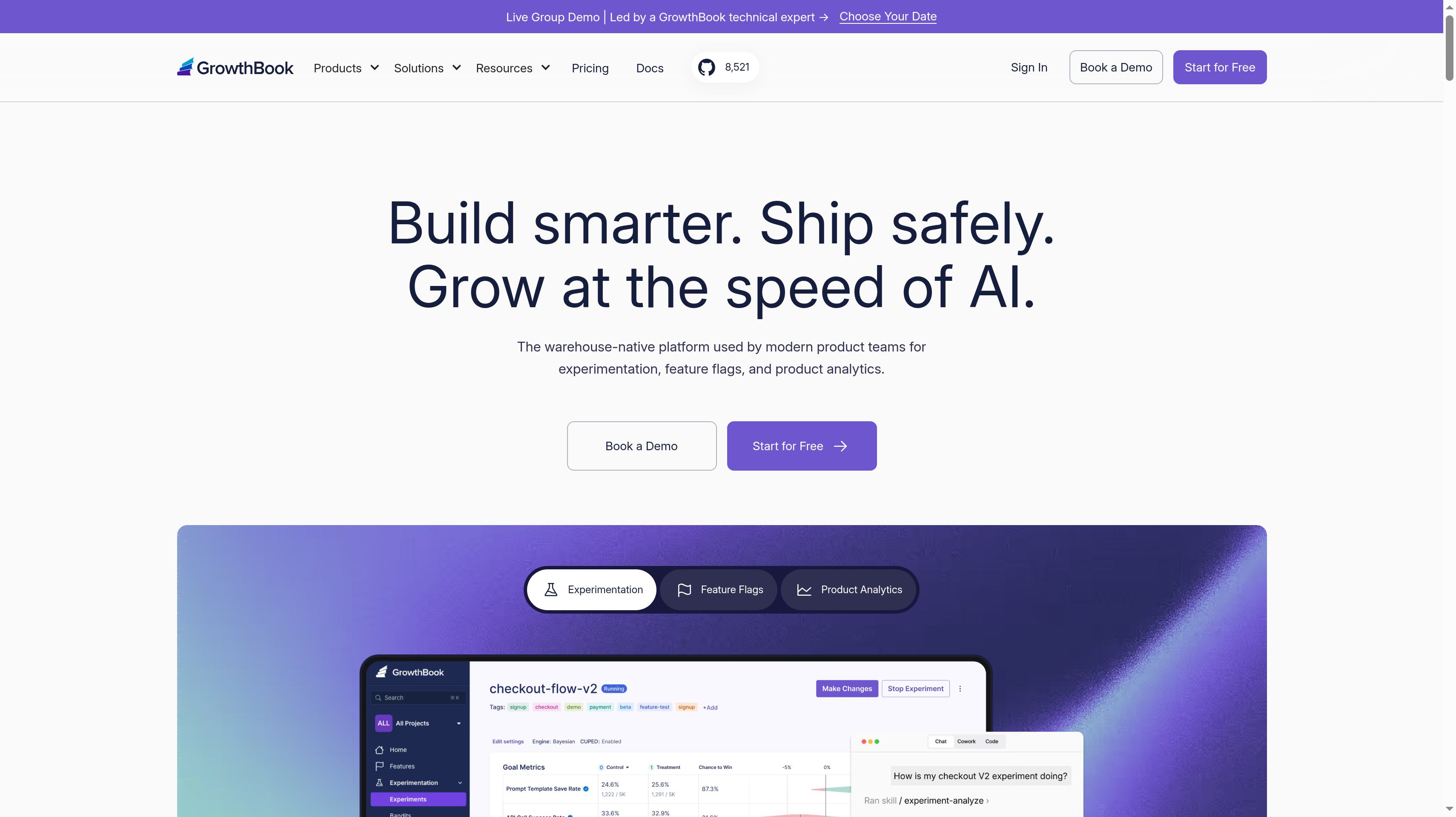
5. GrowthBook, best open-source, warehouse-native option
GrowthBook is an open-source experimentation and feature-flag platform with cloud and self-hosted options. Its warehouse-native approach fits a team that wants experiment analysis to use the data it already maintains. You can bring your own warehouse or use GrowthBook's managed warehouse. Product analytics is also available, but experimentation and control over the data setup are the reasons it belongs here.
The statistical options include Bayesian, frequentist, and sequential testing, plus CUPED, post-stratification, multiple testing corrections, and SRM detection. CUPED uses pre-experiment data to reduce variance when that data is informative. These capabilities give a data team more to evaluate than a single winner label, particularly when several metrics or segments matter to the decision.
Cloud Starter is free for up to three users and one project, with unlimited feature flags, experiments, and traffic. Pro is $40 per seat per month for up to 30 users and three projects. Enterprise has custom pricing and adds SSO and SCIM, approval workflows, and a 99.99% uptime SLA. A team's seats and project organization therefore matter alongside traffic when choosing a plan.
Pro includes an AI visual editor. Multi-arm and contextual bandits extend the experimentation options beyond a fixed traffic split. Your evaluation should include the metric definitions and assignment data your analysts expect to use, whether you choose cloud or self hosting. Have the data owner follow a sample exposure through to its outcome so the workflow matches how your team already measures the product.
Best suited for data teams that want open-source software and experiment analysis built around their warehouse. Cloud and self-hosted deployment options let the team choose who operates the platform as well as where its data lives.
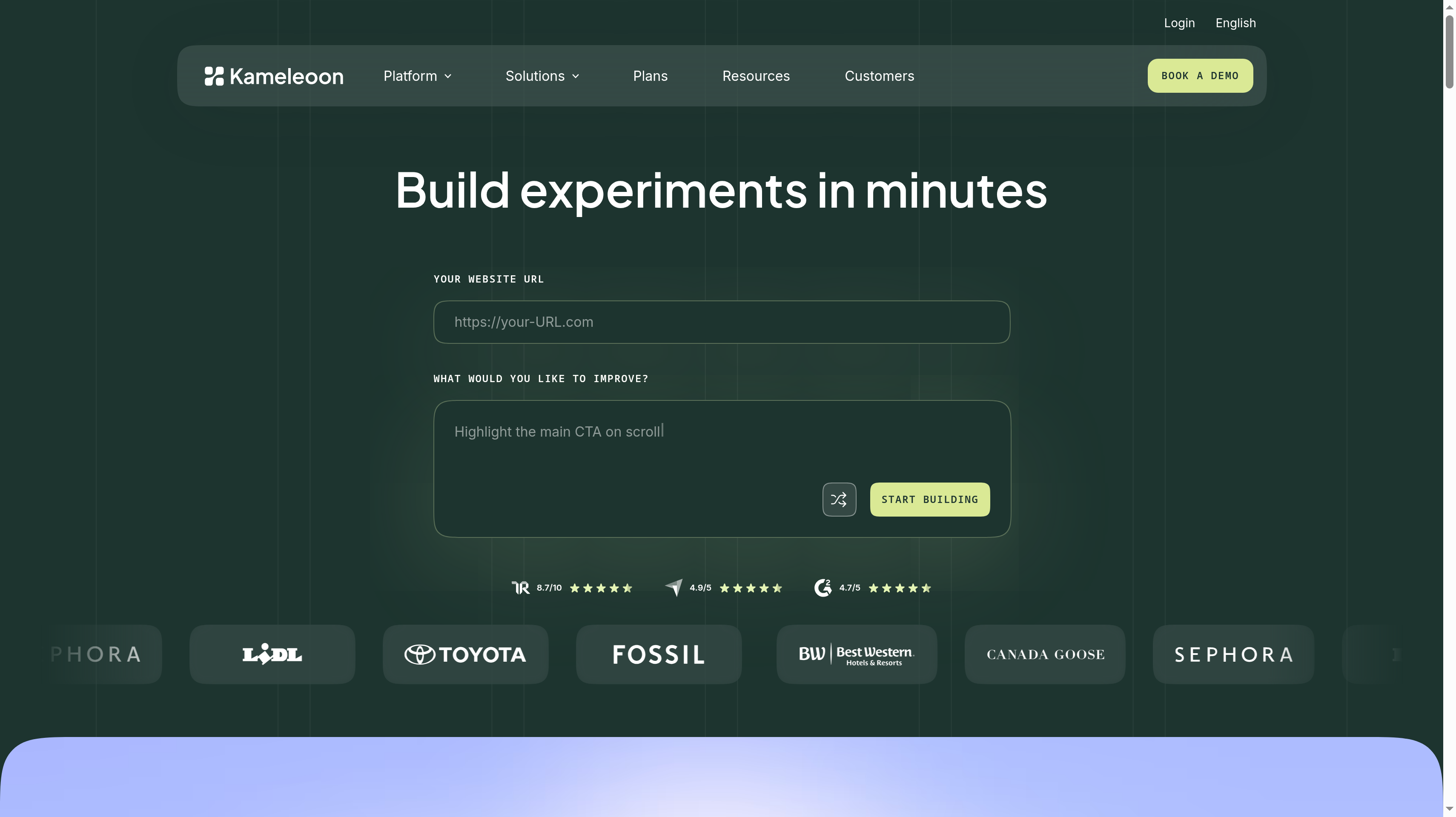
6. Kameleoon, best for AI prompt-based experimentation
Kameleoon's Prompt-Based Experimentation, or PBX, turns a description of a proposed change into test variants. Its AI scans a page for friction, suggests prioritized ideas with Predictive Impact Scoring, and builds front- and back-end variants. The code stays editable, so your team can review or change what the prompt produces before putting it in front of users.
The workflow also helps target audiences, assign traffic, and explain results. That makes it relevant when building the variation is the part that holds up your experimentation backlog. Use a concrete hypothesis in the trial, such as making a plan comparison clearer, and review whether the generated variant changes only what you intended. The speed of generation does not determine the strength of the experiment.
PBX Starter starts at $495 per month and includes up to 10 experiments and 50,000 tested visitors per month. Its free trial lasts 30 days, needs no credit card, and lets you build up to three experiments. Starter includes sequential testing, multiple testing correction, and SRM detection. Enterprise is custom, while feature experimentation, feature management and rollout, and mobile app testing are additional capabilities you can add to Starter.
Kameleoon also supports feature flags and AI personalization. Automatic sample ratio mismatch detection helps identify when actual experiment allocation differs from the intended split. For this ranking, PBX is the distinguishing workflow: a team describes an idea, reviews the generated implementation, and uses a controlled test to judge it.
Best suited for growth teams that want to turn written test ideas into editable variants with AI assistance. PBX gives marketers and developers a shared implementation to review before an experiment launches.
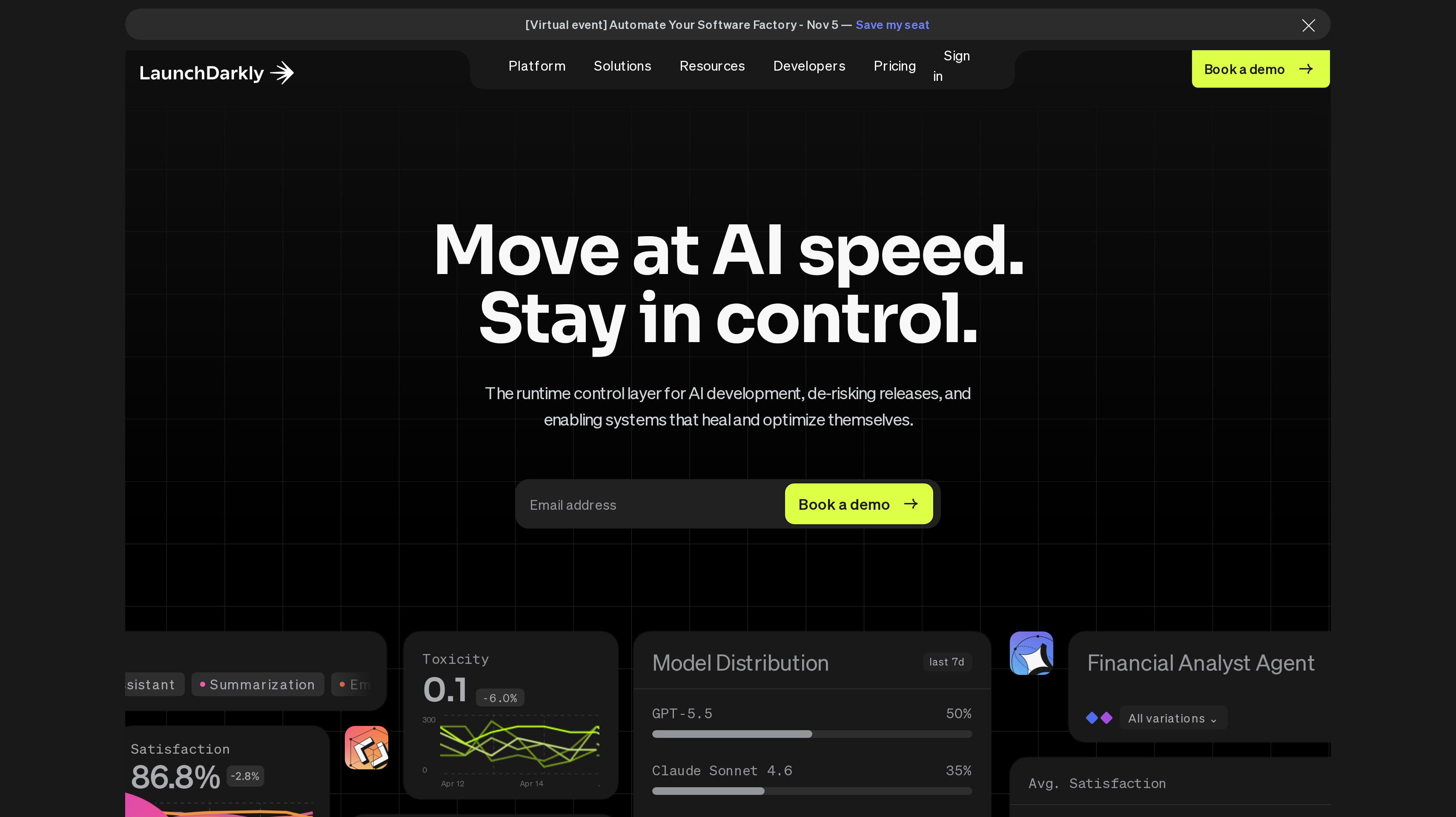
7. LaunchDarkly, best for experiments on engineering-led feature flags
LaunchDarkly connects experimentation to feature flags and release controls. Its experimentation capabilities include A/B/n testing, multi-armed bandits, and holdouts. That makes it a practical fit when your engineering team already thinks of a change as a flag-controlled release, and wants to measure what happens before expanding it to the full user base.
Developer is free forever and includes unlimited seats, feature flags, A/B tests, and experiments. Capacity includes 1,000 client-side monthly active users, five service connections, and 14-day data retention. Those allowances define a concrete evaluation scope for an app or plugin team. The flag count is unlimited, while the delivery capacity still has limits to plan around.
Foundation is pay as you go after a 14-day trial. It costs $10 per service connection per month and $8.33 per 1,000 client-side monthly active users per month, billed yearly, with no platform or seat fees. Enterprise has custom pricing and adds advanced targeting, workflows and approvals, and release automation. Estimate both service connections and client-side users when comparing the paid setup to your application architecture.
Progressive rollouts let your team expand exposure in stages, and Guardian is a paid add-on for release monitoring and automatic rollback. LaunchDarkly has 30 SDKs, alongside observability and AgentControl for AI agents. The experimentation fit is the connection between releasing a feature and evaluating its effect, with holdouts available when you need a group that does not receive the change.
Best suited for engineering teams that ship app and plugin changes behind feature flags and want experiments in that release workflow. The same team can plan exposure, compare outcomes, and decide when to roll a feature out further.
Side-by-Side Comparison
Start with the experiment you need to deliver, then compare the plan that supports it. The table separates website editing from server-side product work and keeps free capacity visible alongside the starting paid plan.
Tool
Starting paid price
Free plan or trial
Testing type
Standout for SaaS teams
VWO (Wingify)
Growth, quote-based
Trial available
Client-side A/B/n and split URL; multivariate on Pro
Visual and code editors; guardrails and SRM detection on Pro
Optimizely
Sales-led quote
Demo available
Client-side web and server-side control; multivariate and bandits
Enterprise experimentation across marketing and engineering
Convert
Growth $299 a month billed annually
15-day trial, no card
Client-side A/B and split URL; server-side testing on Pro
Transparent tested-user plans; QA wizard and SRM check
Statsig
Pro $150 a month, including 5M events
Developer: 2M events a month; unlimited flag checks
Client-side and server-side SDK tests with flags
Bayesian and frequentist stats; warehouse-native on Enterprise
GrowthBook
Pro $40 per seat a month
Starter: 3 users, 1 project; unlimited tests and traffic
Client-side and server-side flag tests; visual editor on Pro
Open source, warehouse-native, CUPED, sequential testing, and SRM detection
Kameleoon
PBX Starter from $495 a month
30-day trial, up to 3 tests, no card
Front- and back-end variants; feature tests available separately
Prompt-based builds with editable code and sequential testing
LaunchDarkly
Foundation from $10 per service connection a month, billed yearly
Developer: 1K client-side MAU, 5 service connections
Client-side and server-side flag-based tests; A/B/n, bandits, holdouts
Experiments connected to progressive releases; Guardian rollback add-on
Which A/B testing tool fits your use case
Choose around the change your team wants to make next. A marketer testing a pricing-page headline and an engineer testing a backend workflow can agree on the same revenue goal while needing different delivery tools.
Bring an example experiment into the evaluation. Include who builds the variation, how assignment works, where the outcome is recorded, and who has authority to stop or ship it. That exercise makes a long capability list easier to judge and gives each person a specific part of the trial to assess.
Use case
What changes about the setup
What to look for
Shortlist pick
Marketing team testing pricing and signup without developers
The marketer needs to edit visible page elements and QA the journey before assigning visitors.
Visual editing, preview and QA tools, split URL testing, and guardrails for the signup result.
VWO; Kameleoon for prompt-generated variants
Enterprise program across brands
Several owners need to coordinate web and server-side work against agreed business goals.
Both delivery paths, a demo built around the team's experiments, and a quote for the intended program.
Optimizely
Privacy-conscious team seeking transparent USD pricing
The technical and privacy owners review data requirements while marketing plans tested-user capacity.
Published allowances, the required test types, and a trial of the intended data flow.
Convert
Early-stage product team wanting free experiments and flags
Engineers instrument the app while product defines exposure and outcome events.
A free event allowance, unlimited flag checks, shared team access, and suitable SDKs.
Statsig
Data team running analysis on its warehouse
Existing metrics and warehouse data become part of the experiment analysis workflow.
Warehouse-native operation, deployment choice, inference methods, CUPED, and allocation health checks.
GrowthBook
Engineering team shipping behind feature flags
The experiment is part of releasing a feature and deciding how far to expand access.
SDKs, A/B/n tests, holdouts, progressive rollouts, and release monitoring options.
LaunchDarkly
Proof: What results look like
Optimizely publishes a 50% conversion lift for The Royal Mint. GrowthBook reports more than $1 million in incremental monthly revenue for Breeze Airways and says Dropbox runs 3 billion feature evaluations daily. The first two figures describe customer outcomes; the Dropbox figure describes operating scale. None is a forecast for your own experiments.
Convert reports more than 40,000 sites optimized over 17 years. That gives context for its website testing history, while your trial should establish whether the delivery and analysis workflow fits your team. Judge a proposed experiment on the business outcome it can measure, the uncertainty around the result, and the other metrics it needs to protect.
Experimentation improves the experience for the visitors you reach; partners can help bring in more of them. According to supastarter founder Jonathan Wilke, affiliates refer more than 50% of the company's customers. Affonso supports that affiliate and partner channel. Read his customer testimonial, then use the affiliate commission calculator to model a reward you can sustain.
FAQ
What are the best A/B testing tools for SaaS?
VWO leads this shortlist for website experimentation, with Optimizely suited to enterprise programs and Convert to teams that want published website testing prices. Statsig and GrowthBook fit product experiments, Kameleoon focuses on prompt-built variants, and LaunchDarkly connects experiments to feature-flag releases. Start with whether your next change belongs on the marketing site or inside the product, then compare the plan needed to deliver and measure it.
What is the difference between client-side and server-side A/B testing?
Client-side testing changes the experience in the browser, often through a visual editor or website code, while server-side testing assigns and delivers behavior through your application. Use the first for visible page changes and the second when you need to change backend logic or a feature's behavior. Either approach still needs consistent assignment, reliable exposure data, and an outcome that matches the hypothesis.
Which A/B testing tools have a free plan?
Statsig Developer, GrowthBook Starter, and LaunchDarkly Developer all include free experimentation capacity. Statsig includes 2 million events per month, GrowthBook allows three users and one project with unlimited experiments and traffic, and LaunchDarkly includes 1,000 client-side monthly active users and five service connections. Choose by the allowance your implementation will actually consume, then use the first experiment to understand how usage grows before moving to a paid plan.
What are good Optimizely alternatives?
VWO is a strong website experimentation alternative, and Convert gives you published entry pricing with full-stack testing on Pro. For product experiments, compare Statsig's event-based plans with GrowthBook's warehouse-native approach or LaunchDarkly's feature-flag workflow. Kameleoon is worth evaluating when turning ideas into testable code is the main bottleneck, especially if marketing and engineering want to review variants generated from the same prompt.
How much traffic do I need to run an A/B test?
There is no universal minimum because sample size depends on your baseline conversion rate, the smallest effect worth detecting, and the statistical power you want. Estimate those before launch and allow time for the outcome to occur, especially when a trial signup converts to a paid subscription later. If the required duration is impractical, focus on a larger change or a more frequent meaningful outcome rather than lowering the evidence standard.
Bayesian vs frequentist: which stats engine should I choose?
Bayesian methods express uncertainty about effects through probabilities, while frequentist methods assess evidence under a specified testing procedure. Choose the approach your team can explain and operate consistently, with a stopping rule that matches the method; sequential testing can support repeated analysis when implemented for that purpose. CUPED is a variance-reduction technique rather than a competing inference method, and SRM detection checks assignment health rather than declaring a winner.
What happened to AB Tasty and Google Optimize?
VWO and AB Tasty united under Wingify, so they are represented as one company in this shortlist. Google ended Google Optimize and Optimize 360 on September 30, 2023. If you are choosing a replacement, start by identifying whether you need visual website tests, server-side experiments, or both, then compare the delivery controls and statistical workflow rather than looking only for a similar editor.
Can I A/B test my affiliate or partner offer?
You can test partner landing pages, commission offers, and signup incentives when you define a clear assignment and measurement plan. Keep experiment assignment in your testing setup; Affonso tracks the referrals, commissions, and payouts behind each variant's partner activity. Use saas affiliate software to run the program, and judge the offer on referred customer value as well as partner signups so the winning incentive supports a sustainable channel.
Try for free
Pick an experiment you can describe in a sentence. Agree on the outcome and the metric you need to protect. Use the testing tool's trial or free plan to follow a real assignment through to its result. Once that workflow is in place, give customers and creators a reason to send new people to your product. Affonso runs the affiliate and partner programs behind those recommendations. Start your Affonso free trial to assess referral tracking, commissions, and payouts with your own offer.
 Affonso
 Silvestro Zinnanti, FounderComparisonNovember 8, 202622 min read